Wednesday, 20 June 2012

A rusty super-tanker lumbers on

Mike Farrar of the NHS Confederation [1] says:

The NHS is like a super-tanker heading for an iceberg. The danger is clearly in view and looming ever larger.

Super-tanker is right! Super-sized, loaded with inertia, and impossible to steer.

But having recognised the nature of the beast, Mr Farrar suggests we steam ever faster ahead.

It is frankly absurd to suggest that important services can only be maintained by increasing spending even faster than the Coalition government has planned. After 13 years of New Labour bureaucratic expansion, there is plenty of fat to be trimmed, and the NHS provides plenty of non-essential procedures, from gender reassignment to IVF.

Even our Soviet-style healthcare system would be sustainable if properly managed, but it seems that today's politicians lack the resolve to reject idiotic demands from the Guardian and the BBC.

Far better, though, to let the free market work its magic. We don't have a National Food Service. Why do we need a National Health Service.

[1] "the membership body for the full range of organisations that commission and provide NHS services" - nicely unbiased, then.

Thursday, 14 June 2012

BBC cheers the demise of cash

A fluffy little piece from the BBC about David Wolman, an author who "says cash is dirty, expensive and should just be pushed off the cliff":


Top quote: "here in the city today I'm not going to buy any pot and I'm not going to visit any strip clubs ... so I should be ok".

No such naughty transactions in the nice clean cashless future!

Let's hope, for his sake, that Wolman never becomes an enemy of the state.

Wednesday, 13 June 2012

Quisling Clarke

A referendum on our membership of the EU is an irrelevance. It is the demand of a few Right-wing journalists and a few extreme nationalist politicians. I cannot think of anything sillier to do than to hold a referendum.
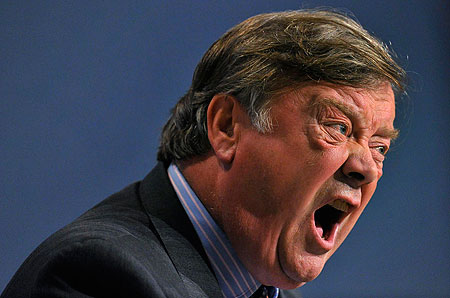
So said The Rt Hon Kenneth Clarke QC MP on Radio 4 recently, according to an email update from The People's Pledge. They also supplied an amusing photograph:


It's hard to escape the conclusion that Clarke is not simply misguided, but actually a Very Bad Man - England's answer to Vidkun Quisling.

Who but a traitor could dismiss as 'silly' the notion that the British people have a right to democratic self-determination?  Who but a traitor could characterise as 'extreme nationalist' the view that laws affecting the British people should be made in Westminster rather than Brussels?

37 years ago, on the 5th of June 1975, British voters were asked
“Do you think that the United Kingdom should stay in the European Community (The Common Market)?”

Today's EU is far from a simple "common market". Many of those who voted for membership in 1975 have regretted their choice, and nobody under the age of 55 has had any say in the matter. An in-out referendum is long overdue.

Tuesday, 12 June 2012

From bad to worse for France

BBC News reports:

President Francois Hollande's Socialists and allies look set to emerge with a majority after first round voting in French parliamentary elections, final results show.
...
When you look at the left bloc as a whole, they have more support than the right, they will have a majority in the new parliament and that will ensure that Mr Hollande can force through the ambitious tax and spend policies that he has set out.

I wonder if M. Hollande has even heard of Frédéric Bastiat, who explained the folly of tax-and-spend in 1850:

When James B. gives a hundred pence to a Government officer, for a really useful service, it is exactly the same as when he gives a hundred sous to a shoemaker for a pair of shoes.

But when James B. gives a hundred sous to a Government officer, and receives nothing for them unless it be annoyances, he might as well give them to a thief. It is nonsense to say that the Government officer will spend these hundred sous to the great profit of national labour; the thief would do the same; and so would James B., if he had not been stopped on the road by the extra-legal parasite, nor by the lawful sponger.

Arguments in favour of government spending have become more sophisticated since then, thanks largely to Keynes, but tax-and-spend is still a bad idea even if 'James B.' or 'the thief' are less inclined to spend than their political masters.

For one thing, the government spends money very badly: it gets poor value-for-money on projects that benefit a small minority of the population.

For another, investment is the key to lasting prosperity, not spending. Wealth is generated by developing more efficient ways to produce goods and services that customers actually desire.

For naive Keynesians and socialist demagogues, boosting GDP is all that matters. C + I + G is the magic formula, and it doesn't matter how things are split, as long as the total rises. Ghost cities and military campaigns are just as good as fusion reactors, and much easier to deliver.

Monday, 11 June 2012

Snowdon: That non-existent slippery slope again

Another excellent post from Christopher Snowdon:

Simon Chapman, 2011:

"The tobacco industry and its stooges played the same slippery slope arguments over advertising bans, sports sponsorship bans and pack warnings . Ad bans started 35 years ago. No alcohol advertising ban and no momentum I’m aware of other than breaking the sport/alcohol nexus. So the slope ain’t very slippery folks …."
Deborah Arnott, 2012:
Thirdly, the “domino theory” i.e. that once a measure has been applied to tobacco it will be applied to other products is patently false. The same argument was used against the ban on tobacco advertising, but 9 years after the tobacco ban in the UK, alcohol advertising is still permitted with no sign of it being prohibited.
The Sunday Telegraph, today:
Doctors call for ban on TV adverts for alcohol

Thirty leading medical bodies and charities have called for a total ban on advertising for alcohol on television... If the demands of the alliance are met, they would have a major impact not just on TV advertising but also on sport sponsorship.
Fancy that!

As usual, the whole article is well worth reading.

Sunday, 10 June 2012

The Register: Gov fights itself over your money

A report from The Register that would be amusing if it wasn't so depressing:

An NHS Trust is disputing a record fine the Information Commissioner's Office has levelled on it for leaving tons of data on patients and staff on hard drives that were sold on eBay instead of being destroyed.

Brighton and Sussex University Hospitals NHS Trust was served a civil monetary penalty of £325,000, the highest handed out since the ICO got the power to lay financial smackdowns in April 2010. The Trust said it didn't agree with the ICO's findings and was appealing the fine.

The ICO claims that the private data of tens of thousands of patients and employees was left on the sold hard drives, including information from the HIV and Genito Urinary Medicine department, which included personal identifiers like dates of birth and occupations as well as sensitive medical data on their STD test results and diagnoses and sexual preferences. The database also held the names and dates of birth of 1,527 HIV positive patients.

While in this case the NHS hasn't actually killed anyone, their incompetence is truly staggering.

There are three obvious, quick and easy steps they could have taken:

  1. Delete the files - your average office admin should be capable of this much.
  2. Securely wipe the disks - standard practice for any competent sysadmin (at work we use standard Linux utilities that repeatedly write random ones and zeros over the disk).
  3. Take a hammer to the hard drive.

Not very difficult. Not the sort of task you need to contract out.

To this depressing but sadly familiar story of government incompetence we add the farce of the ICO fine. It's hard to see what possible good could come of this.

The Register subtitle sums it up nicely: the government fights itself over your money.

Tuesday, 5 June 2012

Reasons to be cheerful

From the Rational Optimist:

15. We can solve all our problems


If you say the world will go on getting better, you are considered mad. If you say catastrophe is imminent, you may expect the Nobel Peace Prize. Bookshops groan with pessimism; airwaves are crammed with doom. I cannot recall a time when I was not being told by somebody that the world could survive only if it abandoned economic growth. But the world will not continue as it is. The human race has become a problem-solving machine: It solves those problems by changing its ways. The real danger comes from slowing change.

16. This depression is not depressing


The Great Depression of the 1930s was just a dip in the upward slope of human living standards. By 1939, even the worst-affected countries, America and Germany, were richer than they'd been in 1930. All sorts of new products and industries were born during the Depression. So growth will resume unless prevented by wrong policies. Someone, somewhere, is tweaking a piece of software, testing a new material, or transferring the gene that will make life easier or more fun.

17. Optimists are right


For 200 years, pessimists have had all the headlines-even though optimists have far more often been right. There is immense vested interest in pessimism. No charity ever raised money by saying things are getting better. No journalist ever got the front page writing a story about how disaster was now less likely. Pressure groups and their customers in the media search even the most cheerful statistics for glimmers of doom. Don't be browbeaten-dare to be an optimist!

Read the entire list.

As regular readers will be aware, I'm prone to pessimism!

I have high hopes for technology, but great scepticism about religion and politics.

If the world is a better place in 50 years' time, it will be despite governments, not because of them.