Showing posts with label bbc. Show all posts

Monday, 8 April 2013

RIP

I heard of Margaret Thatcher's death through Tom Paine's post at The Last Ditch.

Sadly, he first heard from a jubilant lefty:

My tour of my local brewery is rather spoiled by our tour guide punching the air with glee at the news of Margaret Thatcher's end. What kind of human glories in another's death?

I felt compelled to reply:

To be fair, I probably would have celebrated the deaths of Hitler, Mussolini, and Stalin.

The real question is how people can possibly view Thatcher that way.

The sad fact is that far too many of my compatriots are misguided or downright malevolent. Blinded by tribalism, indoctrination or self-interest, they can't see all the good that Thatcher did for Britain.

To my surprise, and to their credit, the BBC's documentary 'Margaret Thatcher: Prime Minister' was really quite respectful.

DK's brief obituary is worth quoting in full, as it nicely sums up my own view:

No, Mrs Thatcher was not a libertarian. But she at least understood that the money that governments' spend is sweated from the toil of the individuals who earn it.

And no, Mrs Thatcher was no infallible goddess. But compared to what came before and (most especially) after, she may as well have been.

And no, Mrs Thatcher did not do everything right: but she had a vision that rose above that of merely lining her own pockets, and she had the balls to see it through.

Wednesday, 6 March 2013

La vida sana

This recent post from Christopher Snowdon is a classic.

How it is that Spaniards are living long, healthy lives despite being overweight, drinking heavily, and smoking a lot?

This all adds up to a bit of a mystery if, like the BBC, you have swallowed the public health fantasy that under-regulation of the food, drink and tobacco industries is the true cause of ill health. Perhaps the Guardian hits the nail on the head with this observation...

Spain has an excellent healthcare system, ranked seventh in 2000 on the only occasion the World Health Organisation has compiled a league table. The UK was 18th.

I suppose we could try to improve the NHS (the envy of the world if you exclude 17 countries who do it better), but that would involve the doctors having to do the job they're being paid for instead of issuing press releases and drawing up lists of demands. And that would be asking far too much, wouldn't it now?

How to get away with murder


Castlebeck, the company at the centre of a BBC-exposed scandal into physical abuse and neglect at one of its care homes, has gone into administration.

Eleven care workers admitted a total of 38 charges last year after they were secretly filmed abusing patients at Winterbourne View near Bristol.

There were two lessons to be learned from this morning's news:

1. If you're a low-paid worker, and you want to abuse old people, join the NHS.

2. If you're a manager, and you want to insulate yourself from risks and responsibility, join the NHS.

How else can we interpret the discrepancy between the handling of events at Winterbourne View and Mid Staffs.

If you work for a private company, and you callously neglect vulnerable patients in your care or knowingly inflict suffering, there's a good chance you will go to jail. And rightly so.

If you work for the NHS, even fatal neglect will go unpunished.

Charles Moore reminds us what 'care' was like at Stafford Hospital:

[The Francis Report] is a great disappointment. It is woolly and over-long, full of jargon and euphemisms and forgettable recommendations. It is a waste of two years. But if you go back to Mr Francis’s first report, in 2010, you are sharply reminded of exactly what all this is about. It has 13 pages on “continence and bladder and bowel care” alone. These include stories about an old man forced to stay on a commode for 55 minutes wearing only a pyjama top, about a woman whose legs were “red raw” because of the effect of her uncleaned faeces, about piles of soiled sheets left at the end of beds, and of bowls full of vomit ditto. A woman arrived at 10am to find her 96-year-old mother-in-law “completely naked… and covered with faeces… It was in her hair, her nails, her hands and on all the cot sides… it was literally everywhere and it was dried.” One nice bureaucratic touch: another woman who found her mother with faeces under her nails asked for them to be cut, but was told that it was “not in the nurses’ remit to cut patients’ nails”.

That treatment alone warrants jail time, but at Stafford Hospital neglect turned fatal:

Statistics show there were between 400 and 1,200 more deaths than would have been expected between 2005 and 2008.

Today we learned that Castlebeck, a private company responsible for 214 residents across 20 UK sites will go into administration. Neglect at just one of their sites, Winterbourne View, proved fatal to their reputation.

In a statement, Daniel Smith, one of the company's partners, said the Winterbourne View home had been immediately closed after the abuse was revealed, with the company "promptly undertaking a root and branch internal review of its operations".

He said: "Whilst the board has focused on quality care provision and restoring confidence in the Castlebeck operations, the impact of two further unit closures in 2011 and reducing occupancy has significantly diluted Castlebeck's subsequent trading capabilities."

In the free market, failure is punished. In the NHS bureaucracy, it is rewarded.

Sir David Nicholson was Chief Executive of the Shropshire and Staffordshire "Strategic Health Authority" at the time of the fatal neglect at Stafford hospital. Today he is Chief Executive of the English NHS. Even after the latest report into the mistreatment, Nicholson refused to step down. Our Coalition Overlords seem quite happy for him to stay in his post. Charles Moore explains:

In retaining his power, Sir David, who is a former member of the Communist Party of Great Britain, had already been endorsed by our political leaders. Jeremy Hunt, the Health Secretary, publicly backed him. David Cameron, in the House of Commons, expressed every confidence in the great man. The political calculation, reinforced by the close relationship between Sir David and the omnipresent Cabinet Secretary, Sir Jeremy Heywood, is that only Sir David can exercise the financial control and manipulation of waiting times required to prevent the NHS exploding politically at the next election. All the deaths at Stafford Hospital occurred under a Labour government, but the Conservatives are being curiously prim about pointing this out. It is in the interests of both parties to play down the lessons of Mid Staffs.

Regular readers may remember Sir Jeremy from my post about him last year. And how appropriate that Sir David was a Communist. A Guardian article from 2006 notes that he was a member of the Communist Party of Great Britain until 1983:

Nicholson has been with the NHS for 29 years. He joined as a graduate trainee in the same year he joined the Communist party, which he then saw as the best vehicle to take forward his passionate support for the anti-apartheid struggle. He says he was not a Eurocommunist: he was among the Tankies who did not see an ideological need to distance themselves from Moscow. During the interview, the working-class lad who has reached the top pokes fun at himself by asking how much of this early baggage needs to appear on the civil service security vetting form that is sitting on his desk awaiting his attention. Perhaps former Communist John Reid, Patricia Hewitt's predecessor as health secretary, might be in the best position to advise?

Whatever might have drawn a Communist to the NHS? I'll leave the conclusion to Charles Moore:

The creation of the NHS in 1948 was not a scheme for making medicine better for patients. It was a way of taking charge of its delivery by centralised bureaucratic diktat, something which happens in no other country today except Cuba, North Korea and (oddly) Canada. It was therefore designed for the people who produced the service rather than for those who received it. Each extra patient was, from the producer’s point of view, a nuisance rather than a benefit. The NHS’s proud boast is that it is free at the point of use, but this is delivered in a variety of much more responsive ways in, for example, Australia, France, the Netherlands, Germany and Spain. Only in this country is the punishment of those whose actions or neglect have killed hundreds of people seen as “scapegoating”.
...
The truth is the exact opposite of what we keep telling ourselves. The NHS is the least caring and most selfishly run important institution in this country. Until we recognise this, there will be plenty more Staffords.

Thursday, 21 February 2013

Right wing extremists

I caught a few seconds of BBC Breakfast this morning. The presenter was describing an attack on football supporters in France as the work of "right wing extremists".

This sort of casual slander by association is so common that it goes unremarked.  I've said it all before, and I won't repeat it all here, but it's clearly ludicrous to imply that National Socialism, with its glorification of an all-powerful state, is somehow a more extreme version of Lady Thatcher's belief in personal responsibility, private enterprise, and a smaller, less intrusive government [1].

It is obvious to any unbiased observer that Fascists and National Socialists are to the left of the political spectrum.  They have much more in common with Old Labour and the BNP than with today's Conservative party.

But if you point this out, you're liable to be deselected as a Conservative candidate and fired from public office, as Rachel Frosh discovered.

Daniel Hannan's recent post on the subject is worth reading:

'I am a Socialist,' Hitler told Otto Strasser in 1930, 'and a very different kind of Socialist from your rich friend, Count Reventlow'.

No one at the time would have regarded it as a controversial statement. The Nazis could hardly have been more open in their socialism, describing themselves with the same terminology as our own SWP: National Socialist German Workers' Party.

Almost everyone in those days accepted that fascism had emerged from the revolutionary Left. Its militants marched on May Day under red flags. Its leaders stood for collectivism, state control of industry, high tariffs, workers' councils. Around Europe, fascists were convinced that, as Hitler told an enthusiastic Mussolini in 1934, 'capitalism has run its course'.

One of the most stunning achievements of the modern Left is to have created a cultural climate where simply to recite these facts is jarring. History is reinterpreted, and it is taken as axiomatic that fascism must have been Right-wing, the logic seemingly being that Left-wing means compassionate and Right-wing means nasty and fascists were nasty.


[1] Thatcher at least professed this belief, and regardless of the realities of the Thatcher era, this is what is commonly understood as Thatcherism - the furthest to 'the right' that Conservatives have ventured in recent decades.

Tuesday, 5 February 2013

BBC pride: Commons backs gay marriage bill

The BBC triumphantly reports:


MPs approve same-sex marriage in England and Wales in a key Commons vote, although more Conservative MPs voted against the bill than for it.

Although I'm an atheist and he's a Christian, my own view is exactly that of Westminster's most promising MP:

My strong view has long been that the government should get out of marriage. I am not alone. In December, Matthew Parris set out essentially the same view in The Spectator and showed that it works in South Africa: Gay marriage the easy way. For The Telegraph, J P Floru explained that one “can quite easily defend the position that the state ought not to be involved in marriage at all” before dealing with the fact that it is involved. The Adam Smith Institute’s Sam Bowman replied in support, concluding, “the next push has to be for true freedom for everybody: for the state to get out of marriage altogether.”
...
As a Christian, I am well aware of the Biblical view of marriage and I support it. However, I do not think it is right for a view based only on faith to be placed in law. If the Bill were merely about whether gay people should be allowed to get married or whether contemporary society accepts homosexuality, then it would be simple. Along with, I think, most people my age and younger, I am relaxed about other adults’ loves and consenting sexual relationships. However, I am not relaxed about muddled law, democratic consent or freedom of religion — whose protection is by no means certain — and I believe strongly that defining marriage is no business of the legislature.

That is why I voted against second reading and why I expect to vote against third reading too.

Monday, 21 January 2013

EU tyre labelling

Last Wednesday I finally got some winter tyres fitted, just in time for the recent snow.

In choosing the tyres, I did what most people do: I read some reviews, and I satisficed. I decided I was happy enough with the Michelin Alpin A4s available from KwikFit, and I booked my appointment. So far they're serving me well.

At no point in this process did I feel the need for guidance from the EU. But someone in Brussels has declared 'market failure' and sought to address it:


European Regulation No 1222/2009 came into force from 1st November 2012. Apparently my lovely new tyres have an 'E' rating for fuel efficiency and a 'C' rating for wet grip. Sad, I know, but somehow I'm managing to hold it together.

For those who care about fuel efficiency, engine and driving style are likely to be much more important factors. To the extent that tyres matter, it's probably enough to keep them properly inflated. As for wet grip, without knowing what temperature they performed the test at, I have no idea whether the rating is relevant. I could dig into the details, but life is too short. I suspect this expensive new labelling system will be widely ignored by consumers, just like the energy efficiency ratings for houses.

If the ratings do manage to influence customer behaviour, they may well be nudging people in the wrong direction. Even assuming that their tests are well designed, they focus attention on a narrow range of features and conditions, and discourage critical thought.

Incidentally, there are no prizes for guessing where the BBC stands on this: New European tyre labelling could save money and lives.

And a bit of googling turns up some classic astroturfing. The new EU labels are supported by The Campaign for Better Tyres.


The Campaign for Better Tyres is being co-ordinated by Environmental Protection UK (EPUK), a national charity that provides expert policy analysis and advice on air quality, land quality, waste, noise and climate change.

Environmental Protection UK was one of a consortium of NGO’s which lobbied for the introduction of the new EU tyre legislation, which sets stricter standards for tyres on energy efficiency, noise and safety and introduces mandatory tyre labelling.

The campaign has been funded with a grant from the Esmée Fairbairn Foundation, with additional financial support from the European Federation for Transport & Environment.

And what about EPUK? A group of concerned citizens devoting their own money to an important cause? It seems not:


The UK's oldest environmental NGO has been forced to close after government cuts to local authority budgets drastically reduced its income.

Amazing. A non-governmental organisation entirely reliant on government funding. Sorry to see them go.

Saturday, 12 January 2013

Auntie says: stay in the EU!

Three EU articles were featured on the BBC News front page this morning.


German MPs warn UK EU exit would be 'economic disaster'


EU debate: Conservative MEP deplores 'pitbull UK' image


Lord Heseltine attacks David Cameron's EU strategy


An EU exit would be an 'ill advised' 'economic disaster' with an 'unknown outcome'.  It would be 'a gamble', 'a punt', and would 'drive away inward investment'.  The EU 'makes the UK more valuable to the US'.  And besides, 'strident Euroscepticism' is 'pretty darned unattractive'.

This is neutrality, BBC style.

Saturday, 5 January 2013

Labour - tirelessly fighting freedom

One of the top stories on BBC News this morning:

Labour has urged the government to consider introducing legal limits on sugar, salt and fat-content in food.

The party says the coalition's emphasis on voluntary agreements with industry is not working.

The Coalition are a sorry bunch of hypocrites. In power they have taken many illiberal steps that both the Conservatives and the Liberal Democrats would have condemned while in opposition. Labour, by contrast, are amazingly consistent on this point - they tirelessly fight to reduce liberty, whether they're in power or out.

I'm of the view that the Conservative party needs to die in order for freedom to progress, and I've said that I'm prepared to endure another 5 years of Labour rule if that's what it takes, but when you see stories like this, 5 years seems like a long time. The Coalition are going slowly and surely in the wrong direction. Labour would race along that same route.

I still think Sean Gabb's fears about Labour, expressed ahead of the last general election, were comically paranoid:

why do I propose to vote Conservative? The answer is that a Conservative Government would probably continue with most of the suicidal or simply demented policies of the Blair and Brown Governments. But, at the end of five years, it would then allow a free election as these things have been commonly understood in England. A re-elected labour Government would not. When these beasts in human form lied their way to office back in 1997, they came in with the same assumptions as Hitler had in 1933. They did not regard themselves as having acquired a limited and renewable leasehold interest, but as having inherited the freehold. They and their clients would never again have to sell their services in any open market. They would reorder the State wholly to their own interest. No private sphere, no ancient and immemorial rights would stand in their way. 1997 was Year Zero of their Thousand Year Reich.

Perhaps I'm just naive, but I don't think the British people would stand for that, even if it is what the likes of Ed Balls secretly desire. Many of our police officers are deeply corrupt and politicised, especially in urban centres, but even among those natural authoritarians, I don't think a majority would go along with it. Then there's the military. If reports from the Olympics are to be believed, our foot soldiers are a generally good natured bunch who identify more with the common people than the political class.

Having said all that, it's frightening that the Labour Party exists, and that it still draws so many votes. This latest nannying idea is as absurd as it is illiberal.

Will they ban the sale of sugar, butter, and salt? If not, it will be easy enough for people to compensate for the fact that their ready-meals are suddenly tasteless.

Or if people don't feel sated, they'll simply eat more, or find more satisfying alternatives. Will the Labour health nazis shut down every chipshop in the land? Will they reintroduce rationing?

Are cheap, calorific carbs like bread, pasta, and potatoes really so good for us? Might saturated fat be the wrong target? Shouldn't grown-ups be free to choose their own food?

According to the BBC, the Labour objective is "to help parents who are trying to do the right thing". Think of the fat kids! But it's already trivial for parents who care to do the right thing. And nothing but a totalitarian system of government child rearing will prevent parents who don't care from neglecting their children.

If the problem of childhood obesity needs to be tackled, we should consider why neglectful parents are having children in the first place. I'm sure we'll find some state interventions that reduce the natural disincentives.

Wednesday, 19 December 2012

Victim stop

A few days ago, Daniel Hannan wrote:

There will always be editors who want the mothers of fallen Servicemen to comment on whether we should be in Afghanistan or who want Doreen Lawrence to be the final arbiter of the government’s policy on race. Still, here is a hard thing that needs saying: victims deserve our sympathy and our respect, but they are no more qualified than anyone else to determine what the law should be.

Most of those brandishing the ‘victims test’ in response to Leveson would be horrified at the suggestion that, say, the parents of a murdered child should decide whether the killer deserved the death penalty. They would point out, correctly, that such parents are emotionally involved, and can’t make a disinterested assessment of what constitutes justice.

An excellent illustration was provided on BBC Breakfast this morning by Jane Sherriff of Bottle Stop.

Following her husband's murder, she has called for all glasses and glass bottles to be BANNED in pubs and clubs after 9pm.

Safer than a pint glass

Personally, I think we should go further. Fights can break out in restaurants too, so it would be much safer if we were all required to use plastic cutlery, just like in cattle class on aeroplanes.

Tuesday, 18 December 2012

Never let a crisis go to waste


Like most Britons (and perhaps unlike most libertarians) I feel instinctively more comfortable in a society where gun ownership is uncommon. Perhaps it helps that our police don't routinely carry weapons (though that's no consolation to Jean Charles de Menezes).

Nevertheless, I'm sickened by the attempts by President Obama and the BBC to exploit the Sandy Hook killings to further the cause of gun control.

Were his tears real?

In a subsequent speech, Obama came out fighting:

We can't tolerate this anymore. These tragedies must end. And to end them we must change ... what choice do we have? We can't accept events like this as routine. Are we really prepared to say that we're powerless? In the face of such carnage? ... Are we prepared to say that such violence visited on our children year after year after year is somehow the price of our freedom?

Perhaps I'm just sensitive to his arrogant and patronising tone, but it all seems very sinister. The warmth of a small child's embrace is indeed a special thing, but I hate to see it abused by Obama's speech writers.

Mises.org today republished an article from 2006 (presumably originally published in the wake of a previous shooting):


Before we even get to the main article, the introduction by Daniel J. Sanchez makes some sobering points:

The heart-rending nightmare that occurred at Sandy Hook Elementary on Friday was not only a product of the pure evil of one individual, but also yet another complete failure of the State. The precious children lost were victims, not only of an individual monster, but of a collective monster. The State made it incredibly difficult for their parents to avoid sending them to mass camps (modern schools) every day, all day. And once there, the State completely failed to keep them safe. More than that, by making the Sandy Hook mass camp a "Gun-Free Zone", the State actually made it impossible for anybody (staff, teachers, parents) to protect them.
...
A sign that says, "Gun-Free Zone" serves not as a warning to murderers, but as a welcome mat.

Tragedies and atrocities inspire an intense desire in the human heart for radical action and change. The radical change that follows Sandy Hook should not be to disarm the general public even further, which would only lead to even more atrocities (at the hands of both independent criminals and the State), but a mass rejection of state schooling. In the wake of this tragedy, parents should pull their children out of public schools for the sake of both their education and safety. And they should cry out, with the protective passion that comes with being a father or mother, for the immediate and complete abolition of all restrictions on home-based and private education. It is time for parents to take their children back from the State.

The main article addresses one of the points that I'd been wondering about: what if the teachers had had guns?

in 1985, only eight states had right-to-carry laws — laws that allow a person to automatically get a permit, provided he passes a background check and completed a training course. Today there are forty states that have some version of these laws. Lott's examination of the data showed that "from 1977 to 1999, states that adopted right-to-carry laws experienced a 60% drop in the rates at which the attacks occur and a 78% drop in the rates at which people are killed from such attacks."

Moreover, he points out that before 1995, it was possible for teachers to bring guns to campus in many states and that "the rash of student shootings at schools began in October 1997 in Pearl, Mississippi after the ban," (my italics).

I haven't investigated the facts for myself, but it seems plausible enough.

Meanwhile, CNN is looking across the pond:


In a country where the constitution is treated with such contempt - where a War on Drugs is pursued without any equivalent of the 18th amendment - how long before American citizens will be disarmed?

How much of a defence do hand guns or even assault rifles offer against helicopter gunships, tanks, and neutron bombs? Not so much, really. But it does make oppression a little less convenient, and sometimes that's all it takes.

UPDATE

Today's Mises.org article features a quote from Justice Joseph Story on the 2nd amendment [Familiar Exposition of the Constitution of the United States (1840)]:
One of the ordinary modes, by which tyrants accomplish their purposes without resistance, is, by disarming the people, and making it an offence to keep arms

Thursday, 6 December 2012

How will Osborne's tinkering affect you?

BBC News is keen to stress the reduced tax burden that we'll enjoy thanks to Osborne's tinkering:

What's happened to taxes?
...people whose incomes put them on the border of the higher-rate 40% income tax bracket will benefit a bit.

The threshold for the 40% rate will rise by 1% in 2014 and again in 2015, from £41,450 to £41,865, and then to £42,285.

Investors will also see some benefit, with the annual exempt amount for capital gains tax rising by 1% to £11,100.

The inheritance tax nil-rate band will rise from £325,000 to £329,000 in 2015-16 [SP: i.e. 1.23%]

Does the BBC expect that tax bands should remain forever fixed? How else to explain their decision to spin 1% rises as a benefit, despite the fact that inflation is running higher than 1%?

Funnily enough, they remember about inflation later in the article:

How will my benefits change in April?
Millions of people claim state benefits of one sort or another, and many working age benefits will rise by 1% in April.

That is probably going to be a cut in real terms though, as it is below the current level of inflation, which is 2.7% under the Consumer Prices Index (CPI) measure.

It would be a lot more transparent, and thus harder for the BBC to spin, if the starting point for every budget was an across-the-board inflation adjustment.

Of course, what we really need is radically simplified tax and benefits system, with most taxes and benefits disappearing altogether.

Friday, 7 September 2012

Should people be forced to take long lunch breaks?

Another classic BBC article:


Nothing excites the BBC more than the 'mandatory'.

Except Obama rallies, perhaps. And melting sea ice.

Am I drinking too much in old age?

Just as I finished reading Christopher Snowdon's latest article, BBC Breakfast began promoting Panorama's upcoming prohibitionist propaganda.

Spurred on by a viewer's email about a grandfather who (shock!) enjoys whisky, Louise Minchin felt obliged to ask: "perhaps we should leave the elderly alone".

Of course, this was just an excuse for her interlocutor, Joan Bakewell ("the government's former voice of older people") to explain why we shouldn't. A small amount of social drinking is ok, you see, but we mustn't drink every day, and never alone and never in excess of the government's unit limits. She herself was guilty of everyday drinking.

Snowdon's article is well worth reading. As well as the Panorama programme, he considers a BBC 'news' piece from yesterday Drink firms 'target young online', Alcohol Concern Cymru claims.

You might assume ... that some sort of research has been published to support allegations of wrong-doing (for it is forbidden to target the 'young' with alcohol advertisements). Alas, there is no mention of it. Instead we get a bunch of quotes from Alcohol Concern which spread unsubstantiated claims designed to advance their campaign for a total ban on alcohol sponsorship. As is typical of the nation's broadcaster when the temperance movement is involved, there are no balancing quotes from drinkers, the drinks industry, freedom-lovers or anyone else who might object to neo-prohibitionism.

Friday, 20 July 2012

0xB16B00B5

BBC News reports:

Microsoft has swiftly fixed an embarrassing gaffe which saw a chunk of code labelled "big boobs".

The hexadecimal string 0xB16B00B5 was discovered lurking in code that helps a Microsoft program work with Linux open source software.

For the BBC this couldn't possibly be a bit of harmless fun ...

"Puerile sniggering at breasts contributes to the continuing impression that software development is a boys' club where girls aren't welcome," Dr Garrett wrote.

Tuesday, 29 May 2012

Elizabeth the Useless

On the reign of QEII, I find myself agreeing with Sean Gabb:

The motto for Queen Victoria’s Diamond Jubilee was “Sixty Years a Queen.” The motto now might as well be “Sixty Years a Rubber Stamp.” If, during the six decades of her reign, England has been transformed from a great and powerful nation and the classic home of civil liberty into a sinister laughing stock, the ultimate responsibility for all that has gone wrong lies with Elizabeth II.

...

Once the politicians make themselves, as a class, irremovable, and once they begin to abolish the rights of the people, it is the duty of the Monarch to step in and rebalance the Constitution. It is then that she must resume her legal powers and exercise them of her own motion.

The need for this duty to be performed has been apparent since at least 1972, when we were lied into the European Union. The Conservatives did not fight the 1970 general election on any promise that they would take us in. When they did take us in, and when Labour kept us in, we were told that it was nothing more than a trade agreement. It turned out very soon to be a device for the politicians to exercise unaccountable power. The Queen should have acted then. Indeed, she should have acted – if not in the extreme sense, of standing forth as a royal dictator– before 1972. She should have resisted the Offensive Weapons Bill and the Firearms Bill, that effectively abolished our right to keep and bear arms for defence. She should have resisted the Bills that abolished most civil juries and that allowed majority verdicts in criminal trials. She should have resisted the numerous private agreements that made our country into an American satrapy. She should have insisted, every time she met her Prime Minister, on keeping the spirit of our old Constitution. There have been many times since 1972 when she should have acted.

At all times, she could have acted – all the way to sacking the Government and dissolving Parliament – without provoking riots in the street

Gabb concludes:

The Queen has not sustained our national identity. It is actually worse than this. By expressing that identity, she has allowed many people to overlook the structures of absolute and unaccountable power that have grown up during her reign. She has fronted a revolution to dispossess us of our country and of our rights within it. How many of the people who turn out on Jubilee Day, with their union flags and street parties, will fully realise that the forms they are celebrating now contain an alien and utterly malign substance?

...

Sooner or later, the luck of the draw may give us a Patriot King.

As for Her Present Majesty, she may be remembered in the history books as Elizabeth the Useless.

Apart from a gratuitous reference to a "bunch of black Marxists", the article seems spot on.

Many of the events that Gabb refers to were before my time, but I remember the Lisbon Treaty. The public were promised a referendum. The Queen would have lost nothing by insisting on it. Indeed, a substantial portion of the population would have thanked her for standing up to our corrupt politicians. And yet, for reasons unclear, she rubber-stamped that act of treason.

Our Queen has succeeded at many things, and is deservedly well regarded around the world, but she has failed abysmally at her most important task: safeguarding our freedom and sovereignty.


UPDATE


I'm not sure whether to be amused or dismayed by this Radio 5 excerpt, in which the presenter is determined not to engage in any serious discussion of the question "Why should we celebrate the Jubilee?". Classic BBC.

Monday, 7 May 2012

Dino farts warmed the earth

Giant dinosaurs could have warmed the planet with their flatulence, say researchers.
British scientists have calculated the methane output of sauropods, including the species known as Brontosaurus.

By scaling up the digestive wind of cows, they estimate that the population of dinosaurs - as a whole - produced 520 million tonnes of gas annually.
How very inconsiderate.

And how grateful we must be to our state broadcaster for highlighting such important facts.

Sunday, 1 April 2012

Booze Britain?

Is this some kind of joke?

I started writing this post on the 12th of March, but between work and fatherhood there isn't much time for blogging these days. As Magnus Magnusson would say, I've started so I'll finish ...

If you haven't yet read this article by Christopher Snowdon, I highly recommend it:
the [ONS's] General Lifestyle Survey is, as Ron Burgundy might say, kind of a big deal. It is the main source of statistics for alcohol consumption and I couldn't help but feel, as I read the Beeb's report, that there was something they weren't telling us.

Sure enough, the text of the report tells a very different story...
Between 2005 and 2010 average weekly alcohol consumption decreased from 14.3 units to 11.5 units per adult. Among men average alcohol consumption decreased from 19.9 units to 15.9 units a week and for women from 9.4 units to 7.6 units a week.
That, folks, is a twenty percent drop in the nation's alcohol consumption in just five years. Is that not newsworthy? Why wouldn't a state broadcaster think licence-payers would want to know a fact like that?

When a few medics wrote a letter to the Telegraph calling for minimum pricing, that was considered newsworthy.

When the Lancet picked a number out of the air and extrapolated it over twenty years, that was considered it newsworthy.

When alcohol-related deaths increased by a statistically insignificant amount, that was considered newsworthy.

But a twenty percent drop in alcohol consumption? Nah, who'd want to hear that? After all, it's hardly going to help the campaign for minimum pricing and a total advertising ban if people discover that the Booze Britain narrative is a myth.
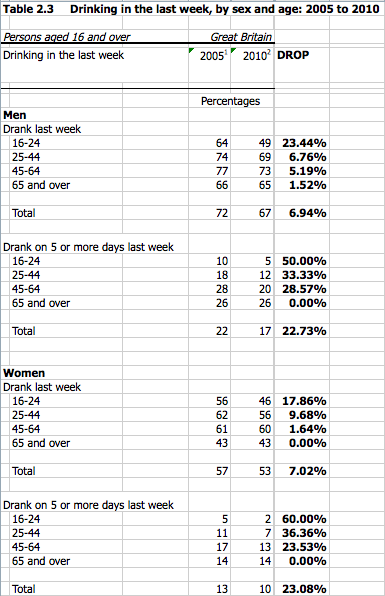
I checked the ONS report myself. Here's the data from Table 2.1 with an added column showing the drop for each category:


That's a drop for both men and women, in every age group. You'd think the Health Nazis at the BBC would be dancing for joy.

Table 2.2 shows the percentage of people exceeding specified amounts in an average week:


That's a drop in every category except one (the percentage of old ladies drinking more than 35 units stayed the same).

Table 2.3 shows drinking patterns for the week leading up to the interview:


For both men and women, in every age group, people are drinking less than they did in 2005 (except for the oldies, who have stuck to their drinking patterns).

It's not until Table 2.4 that the temperance nuts can find anything remotely resembling bad news:


The percentage of men 65 and over drinking more than 4 units in a day has risen from 21 to 22, while the percentage drinking more than 8 units has risen from 6 to 7. Scary stuff!

And Table 2.4 is still overwhelmingly good news from the perspective of those who want us to drink less. The percentage of 'hard drinking' grannies stayed the same at a whopping 2 percent. In every other category, people were drinking less, with the biggest drops in the 16-24 age bracket. Only a third of young men exceeded 4 units (2 pints of Tetley's), and only a quarter exceeded 8 units (3 pints of Kronenbourg), down from about a half and a third, respectively, in 2005.

On almost every metric, Britain is less boozy than it was in 2005. And yet here's the spin we get from the BBC:


Adults aged over 45 are three times as likely to drink alcohol every day as those aged under 45, results of a lifestyle survey suggest.
That older people drink more often than younger people is not news. Look back at those charts. In 2005, only 10% of men aged 16-24 drank 5 days or more in the week before interview, compared with 18%, 28%, and 26% for those aged 25-44, 45-64, and 65+. Women's drinking shows a similar progression (5%, 11%, 17%, 14%).
Although younger adults were less likely to drink every day, the survey suggests that they were more likely to binge drink than older adults.
...
The survey also found that men tended to drink more often than women
Shocking!

Never mind 2005, what about the difference between 2009 and 2010? Overall, alcohol consumption fell by 3%. It fell 11% for those aged 16-24; 1% for 25-44; 4% for 45-64; and 1% for 65 and over. So even compared to last year, we're drinking less. If the BBC were honest and unbiased, their headline would have read "Alcohol consumption continues to fall". But as Chris Snowdon says, that wouldn't help the campaign for minimum pricing (which seems to have finally succeeded).

It's bad enough that we suffer propaganda from a bunch of compulsorily-funded zealots at the BBC. But it seems that the compulsorily-funded statisticians at the ONS also believe that drinking is a problem, and that this is the government's business:

How the data are used and their importance

The Department of Health estimates that the harmful use of alcohol costs the National Health Service around £2.7bn a year1 and 7 per cent of all hospital admissions are alcohol related. Drinking can lead to over 40 medical conditions, including cancer, stroke, hypertension, liver disease and heart disease. Reducing the harm caused by alcohol is therefore a priority for the Government and the devolved administrations. The GHS/GLF is an important source for monitoring trends in alcohol consumption.


£2.7bn sounds like a lot. That's £2,700 million. So how does it compare with what the government collects in taxes on alcohol? Let's have a look at another report available from the ONS: the Alcohol Duties Statistical Bulletin - December 2011:


Chart 1B shows 2011/12 year-to-date (April to February) Total Alcohol Receipts are £8,678m, which is £68m (0.8%) less than the same period in 2010/11.
Now, I'm sure that "harmful use of alcohol" has costs to individuals and organisations other than the NHS, but only public costs should concern the government. Do the non-NHS public costs really add up to £5.978 billion?

I don't know what's more disturbing - that the government churns out this propaganda, or that people believe it. Either way, it's enough to drive any sane person to drink.

Wednesday, 7 March 2012

Propaganda 2012


Most people assume that propaganda is purely a wartime device - something that was inflicted on generations past. But it continues to this day, and nowhere more obviously than in the field of 'public health'.

It works like this:
  1. An anti-tobacco fanatic publishes an absurd report, with claims that aren't supported even by their cherry-picked and carefully-massaged data
  2. The findings are promoted by the BBC News website under the headlines 'Smoke ban: Premature births down' and 'Fewer premature births after smoking ban in Scotland'
  3. BBC Breakfast reports "from a maternity ward in Scotland, where the smoking ban has had an effect on the size and delivery dates of babies"
  4. Ordinary decent people take the BBC report at face value
  5. Any articles questioning the prohibitionist claims reach a much smaller audience. When forwarded to ordinary decent people, the debunking articles often confuse rather than convince. Conflicting claims! Who to trust? Best to err on the side of caution.
  6. The public has been softened up for the next draconian measure:

According to the British Heart Foundation, there are more than nine million smokers in the UK, and smoking remains the UK's biggest cause of avoidable early death.

It says the focus should now shift to the effect of smoking in the home and confined spaces, such as cars, especially where children are present.

A Scottish Government spokesman said: "We are continuing to build upon the achievements made to protect future generations from the devastating effects of smoking such as bans on cigarette vending machines and the displays in shops.

"We are committed to ensuring a new comprehensive robust tobacco control strategy for Scotland is developed this year. This strategy will focus on prevention and cessation and include ambitious targets for reducing smoking across Scotland."

Do read the whole BBC News article, but especially read Christopher Snowdon's excellent blog post on the subject.

On the "drop in the number of babies born prematurely or with low birthweight", the BBC article notes, in passing, that

The investigators believe both are linked to the smoking ban, even though these rates started to go down some months before the ban was introduced and smoking incidence started to creep up again shortly after the ban.
and

while their work suggests a link, it is not proof that one thing necessarily causes another. As with all retrospective studies like this, it is impossible to rule out entirely all other factors that might have influenced the finding.

This is balance, BBC style. The intended message has already been conveyed forcefully in the headline and first eight paragraphs, and it is hammered home again in the concluding paragraphs (quoted above). Even their qualifications stress that "the investigators believe both are linked to the smoking ban" and that "their work suggests a link".

Here, from Christopher Snowdon's article, are the relevant graphs:

And here's the data from the report itself:

Are the BBC headlines justified?

Smoke ban: Premature births down

Fewer premature births after smoking ban in Scotland

Make up your own mind.

Saturday, 3 March 2012

What's the cause of widespread pub closures?

BBC News reports:
The rising price of beer, fuelled by increases in taxation, has been blamed for widespread pub closures - the Campaign for Real Ale says 14 are shutting down each week. In response, Forsyth says, consumers have taken advantage of cheap supermarket offers and switched to drinking at home.
I suppose we should be grateful that they mentioned the impact of tax rises, but has it not occurred to the author that the smoking ban might have something to do with people switching to drinking at home? Or has he considered this, and decided not to mention it?

Sunday, 5 February 2012

Alcohol Concern at the BBC

Recorded here for posterity:

Drinking "just a little more than they should" puts people at risk of serious illness including heart disease, stroke and cancer, the government is warning.

A TV advertising campaign is being launched to press home the message.

It warns regularly drinking two large glasses of wine or two strong pints of beer a day triples mouth cancer risk and doubles high blood pressure risk.

BBC News,

Emily Robinson, of Alcohol Concern, welcomed the campaign.

But she added: "Telling people they could be drinking too much can't be our only solution to the country's alcohol problem.

"We also need to see minimum alcohol pricing brought in as soon as possible, as well as making sure high quality services are available for people who may have developed a serious alcohol problem."

Ah yes, another wonderfully balanced article from our impartial state broadcaster.

One of these days I'll get around to tracking the mean time between BBC articles calling for restrictions on alcohol. I suspect there's at least one a week.