Showing posts with label tax. Show all posts

Friday, 26 April 2013

A ban on external accountants working inside government

BBC News reports:


A ban on external accountants working inside government, to stop them telling clients about tax loopholes they have found, has been urged by MPs.

To Labour MPs it seems that wherever there's a problem, a ban is the answer.

As usual, their scheme is not only illiberal and heavy-handed, but doomed to failure. As long as there are loopholes, accountants will find them and assist their clients in exploiting them.

The obvious answer is to simplify the tax code to the point that nobody needs tax accountants.

Abolishing corporation tax would be a good start.

Friday, 8 March 2013

Taxing benefits

BBC News reports:

Another idea that has been worked on is taxing benefits. Official Treasury numbers seen by Newsnight show that taxing child benefit would raise £1.5bn, taxing DLA £800m and if you taxed the Winter Fuel Payment (which Vince Cable advocated on Thursday), you would raise £200m.

But the trouble with this is that the Treasury hate it. They point out that it would pull huge numbers of people into self-assessment, making it very messy administratively and politically. The Inland Revenue would probably have to hire 5,000 extra staff to deal with the extra work. But it is £2.5bn and every penny counts.

How desperate do you have to be to consider such an obviously insane idea?

Monday, 28 January 2013

Starbucks versus Nick Cohen

John Phelan has a good article at The Cobden Centre, attacking a ludicrous piece in The Spectator by Nick Cohen.

It's hard to say whether Cohen is ignorant or disingenuous. He writes:

Now libetarianism, once an interesting anti-authoritarian philosophy, has degenerated into servile money worship, and taken large numbers of right-wing thinkers down with it. Conservative writers cannot see anything wrong with plutocrats gaining an unfair advantage, and do not think about how powerful interests that can demand state bailouts distort markets.

Libertarian is by definition an anti-authoritarian philosophy. Any philosophy that supports authoritarianism is not libertarianism.

As for 'money worship', this plays no part in libertarian theory, nor do I see it in practice. Libertarians respect honestly earned wealth because they recognise that businessmen in a free society are compelled to serve their customers, and those who serve their customers best deserve to be best rewarded.

Far from libertarianism taking "large numbers of right-wing thinkers down with it", it is libertarianism that stresses "how powerful interests that can demand state bailouts distort markets" and libertarianism which condemns "unfair advantage".

Cohen seems to think that corporations only contribute to society by paying taxes:

[Starbuck’s UK managing director] has not asked himself why the British should care if Starbucks cuts back on investment or leaves altogether. It has paid £8.5 million in corporation tax, despite total sales of £3 billion.
...
From the point of view of the Exchequer, it is a matter of supreme indifference whether Starbucks stays or goes.

The Exchequer probably would care, because the central government creams off 20% of all coffee sales in the form of VAT. They also take income tax and national insurance from thousands of Starbucks employees. Cohen's idea is that "many other chains and thousands of independent coffee shops" would pick up the slack, but this is not certain. Deprived of their preferred coffee shop, people might just drink less coffee. The pie could get smaller.

Cohen's problem is that he fails to distinguish between "the Exchequer" and "the British". People who choose Starbucks over Costa would not consider its departure "a matter of supreme indifference". Every Starbucks customer prefers the products they purchase to the money in their pocket. Starbucks makes each customer better off. Even if Starbucks paid no tax at all, it would be offering a valuable service.

If people are concerned about tax avoidance, they should campaign for a simpler tax system.

Thursday, 10 January 2013

Depardieu defects

Through Andy Duncan's blog, I discovered a great article by Jeff Berwick on Gérard Depardieu's 'defection' to Russia. As Andy points out, we're unlikely to hear that word used in the mainstream media, but it seems to fit.

If I had told you twenty years ago that the rich of the West would have to flee to Russia for economic freedom, you might have slapped me for lying.

But that is exactly what is going on today as Western governments get increasingly brazen about their true kleptocratic natures, seeking to “expropriate the expropriators” in order to save their unsustainable welfare (European) and warfare (American) states.

Europe has never been the land of economic freedom, but it wasn't as bad as the Communist states of the USSR which kept roughly 100 percent of their citizens' income, a condition commonly known as slavery. Before the fall of Communism, people were actually risking their lives trying to escape places like Russia and East Germany. Now as Russia moves away from economic slavery toward economic freedom and Western Europe takes giant steps toward communism, the rich of the West are both the first targets—and the first escapees.

What I can't understand is why David Cameron isn't keen to welcome all of these rich refugees. Why not offer a low, flat income tax here in Britain? It wouldn't need to be as low as Russia's (reportedly 13%), because London is still a more attractive destination for most people than Moscow.

We could also abolish corporation tax, so that major corporations use us as their European headquarters instead of Ireland.

At the same time, rich Britons wouldn't waste their time contemplating tax avoidance and emigration.

We could do all of this while remaining in the EU. Indeed, we could exploit the free movement of people and capital to attract the right sort of Europeans to our shores - the kind who wouldn't put any strain on 'resources'.

In short, why aren't we a tax haven?

Thursday, 6 December 2012

How will Osborne's tinkering affect you?

BBC News is keen to stress the reduced tax burden that we'll enjoy thanks to Osborne's tinkering:

What's happened to taxes?
...people whose incomes put them on the border of the higher-rate 40% income tax bracket will benefit a bit.

The threshold for the 40% rate will rise by 1% in 2014 and again in 2015, from £41,450 to £41,865, and then to £42,285.

Investors will also see some benefit, with the annual exempt amount for capital gains tax rising by 1% to £11,100.

The inheritance tax nil-rate band will rise from £325,000 to £329,000 in 2015-16 [SP: i.e. 1.23%]

Does the BBC expect that tax bands should remain forever fixed? How else to explain their decision to spin 1% rises as a benefit, despite the fact that inflation is running higher than 1%?

Funnily enough, they remember about inflation later in the article:

How will my benefits change in April?
Millions of people claim state benefits of one sort or another, and many working age benefits will rise by 1% in April.

That is probably going to be a cut in real terms though, as it is below the current level of inflation, which is 2.7% under the Consumer Prices Index (CPI) measure.

It would be a lot more transparent, and thus harder for the BBC to spin, if the starting point for every budget was an across-the-board inflation adjustment.

Of course, what we really need is radically simplified tax and benefits system, with most taxes and benefits disappearing altogether.

Monday, 28 May 2012

The single income tax

I've long thought that tax simplification should receive cross-party support. Aside from the accountants and bureaucrats, nobody gains from a complex tax code. With a simpler system, the government could get higher revenue at lower rates (though of course I'd prefer for it to get lower revenue at much lower rates).

I haven't yet found time to read all 421 pages (!) of The Single Income Tax (PDF), but the summary is promising:

To create the conditions for stronger economic growth and more jobs, while treating taxpayers fairly, the Government must reform taxes to make them lower, simpler and more transparent.

To achieve this, the 2020 Tax Commission recommends the Single Income Tax, which can be introduced in six steps:

  1. Taxes should be cut to 33 per cent of national income
  2. Marginal tax rates should not exceed 30 per cent, and the personal allowance should rise to £10,000
  3. Taxes on capital and labour income disguised as business taxes should be abolished, and replaced with a tax on distributed income
  4. Transaction, wealth and inheritance taxes should be abolished
  5. Other consumption taxes need to stay for now, but transport taxes should be cut
  6. Local authorities should raise half of their spending power from local taxes

Browsing through the table of contents, I found a conciliatory point that seemed questionable:

  • 2.7. Tax evasion is immoral as well as illegal, and in some cases legal tax avoidance is also immoral

But without such sops to the 'statist quo', the report would probably have been rejected out of hand by those in power. As Anthony Evans, a commissioner on the report, puts it:

Personally, I find it hard to truly advocate 30% tax rates. But this isn’t about what we’d like in theory. It’s about mapping out a direction of travel, shifting debate, and engaging with policymakers and the public. If you believe such aims are futile, then you may be disappointed. But if you want a well researched and implementable proposal for radical tax changes – this is it.

And as Alistair Heath says, tax reform is long overdue but has potential to dramatically increase prosperity:

IT is time for Britain to make a vital choice. Our economy is stagnant, with unemployment at horrendous levels, crippled by excessive public spending and a punitive tax system. There are two options. We can either tweak the status quo – try to keep a lid on spending, reform bits of the public sector and hope for the best. Such a soft option may stave off an immediate budgetary crisis but it will condemn Britain to permanent relative decline. Or we can change course: reduce public spending as a share of GDP more significantly, adopt an entirely new tax system fit for the 21st Century and establish the UK as a global trading hub, generating renewed prosperity for all those who live and work here.
Related articles:

Sunday, 1 April 2012

Booze Britain?

Is this some kind of joke?

I started writing this post on the 12th of March, but between work and fatherhood there isn't much time for blogging these days. As Magnus Magnusson would say, I've started so I'll finish ...

If you haven't yet read this article by Christopher Snowdon, I highly recommend it:
the [ONS's] General Lifestyle Survey is, as Ron Burgundy might say, kind of a big deal. It is the main source of statistics for alcohol consumption and I couldn't help but feel, as I read the Beeb's report, that there was something they weren't telling us.

Sure enough, the text of the report tells a very different story...
Between 2005 and 2010 average weekly alcohol consumption decreased from 14.3 units to 11.5 units per adult. Among men average alcohol consumption decreased from 19.9 units to 15.9 units a week and for women from 9.4 units to 7.6 units a week.
That, folks, is a twenty percent drop in the nation's alcohol consumption in just five years. Is that not newsworthy? Why wouldn't a state broadcaster think licence-payers would want to know a fact like that?

When a few medics wrote a letter to the Telegraph calling for minimum pricing, that was considered newsworthy.

When the Lancet picked a number out of the air and extrapolated it over twenty years, that was considered it newsworthy.

When alcohol-related deaths increased by a statistically insignificant amount, that was considered newsworthy.

But a twenty percent drop in alcohol consumption? Nah, who'd want to hear that? After all, it's hardly going to help the campaign for minimum pricing and a total advertising ban if people discover that the Booze Britain narrative is a myth.
I checked the ONS report myself. Here's the data from Table 2.1 with an added column showing the drop for each category:


That's a drop for both men and women, in every age group. You'd think the Health Nazis at the BBC would be dancing for joy.

Table 2.2 shows the percentage of people exceeding specified amounts in an average week:


That's a drop in every category except one (the percentage of old ladies drinking more than 35 units stayed the same).

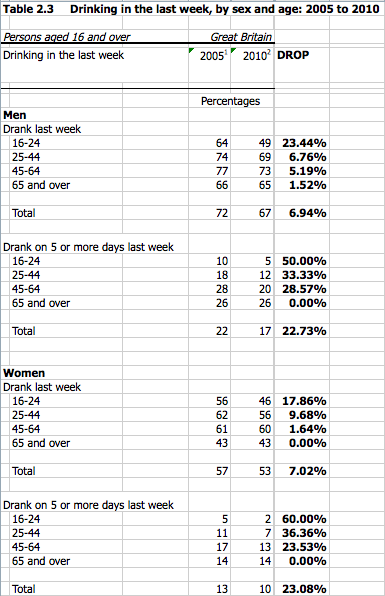
Table 2.3 shows drinking patterns for the week leading up to the interview:


For both men and women, in every age group, people are drinking less than they did in 2005 (except for the oldies, who have stuck to their drinking patterns).

It's not until Table 2.4 that the temperance nuts can find anything remotely resembling bad news:


The percentage of men 65 and over drinking more than 4 units in a day has risen from 21 to 22, while the percentage drinking more than 8 units has risen from 6 to 7. Scary stuff!

And Table 2.4 is still overwhelmingly good news from the perspective of those who want us to drink less. The percentage of 'hard drinking' grannies stayed the same at a whopping 2 percent. In every other category, people were drinking less, with the biggest drops in the 16-24 age bracket. Only a third of young men exceeded 4 units (2 pints of Tetley's), and only a quarter exceeded 8 units (3 pints of Kronenbourg), down from about a half and a third, respectively, in 2005.

On almost every metric, Britain is less boozy than it was in 2005. And yet here's the spin we get from the BBC:


Adults aged over 45 are three times as likely to drink alcohol every day as those aged under 45, results of a lifestyle survey suggest.
That older people drink more often than younger people is not news. Look back at those charts. In 2005, only 10% of men aged 16-24 drank 5 days or more in the week before interview, compared with 18%, 28%, and 26% for those aged 25-44, 45-64, and 65+. Women's drinking shows a similar progression (5%, 11%, 17%, 14%).
Although younger adults were less likely to drink every day, the survey suggests that they were more likely to binge drink than older adults.
...
The survey also found that men tended to drink more often than women
Shocking!

Never mind 2005, what about the difference between 2009 and 2010? Overall, alcohol consumption fell by 3%. It fell 11% for those aged 16-24; 1% for 25-44; 4% for 45-64; and 1% for 65 and over. So even compared to last year, we're drinking less. If the BBC were honest and unbiased, their headline would have read "Alcohol consumption continues to fall". But as Chris Snowdon says, that wouldn't help the campaign for minimum pricing (which seems to have finally succeeded).

It's bad enough that we suffer propaganda from a bunch of compulsorily-funded zealots at the BBC. But it seems that the compulsorily-funded statisticians at the ONS also believe that drinking is a problem, and that this is the government's business:

How the data are used and their importance

The Department of Health estimates that the harmful use of alcohol costs the National Health Service around £2.7bn a year1 and 7 per cent of all hospital admissions are alcohol related. Drinking can lead to over 40 medical conditions, including cancer, stroke, hypertension, liver disease and heart disease. Reducing the harm caused by alcohol is therefore a priority for the Government and the devolved administrations. The GHS/GLF is an important source for monitoring trends in alcohol consumption.


£2.7bn sounds like a lot. That's £2,700 million. So how does it compare with what the government collects in taxes on alcohol? Let's have a look at another report available from the ONS: the Alcohol Duties Statistical Bulletin - December 2011:


Chart 1B shows 2011/12 year-to-date (April to February) Total Alcohol Receipts are £8,678m, which is £68m (0.8%) less than the same period in 2010/11.
Now, I'm sure that "harmful use of alcohol" has costs to individuals and organisations other than the NHS, but only public costs should concern the government. Do the non-NHS public costs really add up to £5.978 billion?

I don't know what's more disturbing - that the government churns out this propaganda, or that people believe it. Either way, it's enough to drive any sane person to drink.

Saturday, 3 March 2012

What's the cause of widespread pub closures?

BBC News reports:
The rising price of beer, fuelled by increases in taxation, has been blamed for widespread pub closures - the Campaign for Real Ale says 14 are shutting down each week. In response, Forsyth says, consumers have taken advantage of cheap supermarket offers and switched to drinking at home.
I suppose we should be grateful that they mentioned the impact of tax rises, but has it not occurred to the author that the smoking ban might have something to do with people switching to drinking at home? Or has he considered this, and decided not to mention it?

Wednesday, 8 February 2012

Democracy and property rights

An email reached me today from Detlev Schlichter, who had some frighteningly insightful comments on democracy and property rights:
The way modern democracy has developed, it is entirely incompatible with any notion of property rights. Property rights today are never absolute, they are conditional. All property in our society belongs ultimately to the state. You are simply allowed to use some property as long as you keep paying whatever fees and levies the state imposes on you, and as long as you conduct yourself according to what the state deems appropriate. The moment you fall behind paying your dues, any and all your property is at risk of confiscation.

As Doug Casey says: Try not paying your property tax for a year or two and you will find out who really owns your house.

Already more than 160 years ago, the German philosopher Max Stirner wrote that the existence of a state and the notion of private property are incompatible. The state has the monopoly on legalized violence, on taxation and on legislation, and those who run this monopoly have no interest in protecting your property but every interest, and every means, to invade it. While that was also true of monarchic states, at least there it appears that the inherent class chasm between rulers and the ruled encouraged some restraint: kings and dukes were afraid of the mob. In democracy, the state represents the mob. It could well be the fate of every democracy to ultimately descend into mob rule, and no environment is more suitable for this than a prolonged economic crisis.
I've been reflecting recently on how a stable, minimal state could be maintained without the injustice of an aristocracy.

The universal franchise does seem to be a large part of the problem. As a believer in meritocracy, I couldn't countenance any sort of caste system, but it cannot be right, or sustainable, for net beneficiaries of the state to vote for increasingly generous payments from a wealth-producing minority.

Rothbard argues quite convincingly that there is no such thing as a just tax. For now, though, I'm still inclined toward minarchism rather than anarcho-capitalism, so I seek a tax regime that is
The best I've been able to come up with so far is a system that taxes passports, and nothing else.

Passports would not be required to leave the UK, though other countries may still require one for entry. The passport office would require no more personal information than at present. Overall, the government would need to know much less about us. How you make your money, for example, would be no business of the state.

Passports would come at a cost sufficient to fund a police force, courts, and a military capable of defending us against credible threats.

Passports would also entail voting rights. Those unable or unprepared to meet the fee would be disenfranchised, but it hardly seems the right word in this context. Anyone would be free to vote, provided they fund the (minimal) services they enjoy, and the cost would hopefully be less than is currently collected through council tax.

As I wrote in 2010:
In 1900 the government spent £265 million, equivalent to £24 billion today. If spending had been kept at those levels, council tax would suffice to cover it.
In 30 years' time, the world will be a very different place. It seems unlikely that a welfare state on current lines will exist. Sooner or later, we shall all have to live within our means. The buck cannot indefinitely be passed to the next generation. We can only hope that there is not too much bloodshed in the transition.

[1] I remember a good article on the deadweight costs of taxation that Jamie Whyte published with The Times. It is currently stuck behind a paywall that libertarians can't begrudge, however much we may lament the passing of free linking.

Monday, 28 November 2011

Gerald Warner on forced funding for political parties

A good article from Gerald Warner for Scotland on Sunday:
‘IT IS difficult to conceive of a more difficult climate in which to propose any increase in public support for political parties.” Those insightful words came last week from Sir Christopher Kelly, chairman of the Committee on Standards in Public Life.
...
Unfortunately, despite delivering himself of this common-sense verdict, Sir Christopher’s committee recommended exactly the suicidal course of action he had just identified: taxpayer subvention of the predatory gangs that call themselves political parties and have brought Britain to its knees over recent decades
Warner concludes:

Party politics is not about “public service”; it is about egomaniacs attempting to impose their views on society or, less harmfully, good old-fashioned self-seekers looking for a cushy billet. If they cannot find backers willing to support their mostly unhealthy ambitions, it is in no way the duty of normal people to part with their dwindling cash to support them. Any attempt to impose such a burden on taxpayers, as even the parties seem now implicitly to admit, would provoke a tsunami of resentment.

Wednesday, 23 November 2011

We are the 60%

In countries in which the poor have the exclusive power of making the laws, no great economy of public expenditure ought to be expected; that expenditure will always be considerable either because the taxes cannot weigh upon those who levy them or because they are levied in such a manner as not to reach these poorer classes. In other words, the government of the democracy is the only one under which the power that votes the taxes escapes the payment of them.

In vain will it be objected that the true interest of the people is to spare the fortunes of the rich, since they must suffer in the long run from the general impoverishment which will ensue.

Alexis de Tocqueville, 1835 - Democracy in America, Volume I, Chapter 13


Yesterday I discovered a BBC News article entitled Tax: Do you give more than you get?

Though my household is by no means rich, it seems we are in the top decile. It turns out that a childless couple with both partners earning £32000 before tax is enough. To count among the 9th decile, all you need is £24000 each; for the 8th decile: £19000 each; for the 7th decile: £16000 each. All of these deciles are net contributors, according to the BBC (to the tune of £27221, £12433, £5457, and £1900 respectively).


There are a few things to note here. Firstly, £16000 isn't a huge salary. I'd wager that almost everyone of working age could manage it, if they tried hard enough. According to my calculations, you could achieve it by working 53 hours a week at the minimum wage [1], for 50 weeks. A hard life, but nothing like what our ancestors had to face. On the other hand, you have to ask why people would bother — all that work for the privilege of contributing £1900 (6 weeks of labour) to those who aren't inclined to work as hard.

Secondly, only the top 4 deciles are net contributors; 60% of households are net recipients. In a democracy, we should not be surprised that taxes "are levied in such a manner as not to reach these poorer classes".

Thirdly, the BBC calculator understates the weight of tax-eaters. As Rothbard puts it

The tax consumers consist of the full-time bureaucracy and politicians in power, as well as the groups which receive net subsidies, i.e., which receive more from the government than they pay to the government. These include the receivers of government contracts and of government expenditures on goods and services produced in the private sector. It is not always easy to detect the net subsidized in practice, but this caste can always be conceptually identified.
...
it is inherently impossible for bureaucrats to pay income taxes uniformly with everyone else. And therefore the ideal of uniform income taxation for all is an impossible goal. We repeat that the bureaucrat who receives $8,000 a year income and then hands $1,500 back to the government is engaging in a mere bookkeeping transaction of no economic importance (aside from the waste of paper and records involved). For he does not and cannot pay taxes; he simply receives $6,500 a year from the tax fund.


So we have at least 60% of households as net recipients of taxes. Are they grateful? On the contrary, many of them are are disappointed that they haven't succeeded in screwing more money out of the top 1%. Such is the tyranny of the majority.

[1] From 1 October 2011, the minimum wage for those 21 or older is (£6.08 for those 21+, from 1 October 2011)

Saturday, 17 September 2011

Fiscally responsible states

In a recent article, James Delingpole wrote:
Sure a "successful Euro" would be massively in Britain's interests if we lived in a parallel universe where: the EU were a democratic entity which prized, above all else, the sovereign rights of its constituent states; the EU were not a two-speed economy where the interests of heavily socialised, terminally corrupt spendthrift southern whacko member states like Greece diverged enormously from those of stolid, hardworking, fiscally responsible states like Germany;
Though I accept the spirit of what he's saying, I took issue with his last point:
Last time I checked, Germany had a massive national debt (1.8tn euro according to this site: http://nationaldebtclocks.com/... ).

It's only fiscally responsible by comparison to other states!
To be fiscally responsible, a government must balance the books, and take steps to eliminate past debts (personally, I think default is the best option, but failing that, debt should be steadily paid down to zero by running budget surpluses).

I'd also suggest that there's nothing responsible about balancing the books on a high-taxing, high-spending model, as government control of large portions of national income will make citizens poorer than they otherwise would be. Bureaucrats have neither the knowledge nor the incentive to spend efficiently.

But as it happens, I can't think of a government that has consistently balanced the books on a high-spending, high-tax model. It would seem there are limits to how much revenue the government can collect through taxation alone.

Friday, 26 August 2011

A terrible waste

Back in April, BBC News featured this story:

Oxford gardeners will soon have to pay to have their green waste recycled, with the council blaming government cuts for the decision.

The current scheme where green hessian sacks are emptied by the city council will be replaced by a chargeable service from 3 May.

Residents wishing to recycle will have to opt for a brown wheelie bin or purchase eco refuse sacks.

Councillor John Tanner said: "The new scheme is entirely voluntary."

He added "We hope people will continue to recycle."

Subscribing to the wheelie bin service will cost £35 per year. The eco sacks will be sold in packs of 10 for £25 and 20 for £35.

Mr Tanner, who is a board member for Cleaner, Greener Oxford, said: "The government cuts have forced us to introduce a paid-for garden waste service.

Staggering.

So this previously free service is now going to cost £35/year, but it's "entirely voluntary". Presumably I can burn my garden waste, leave it to rot in a heap, put it in ordinary black bin bags along with the food waste (verboten, of course), or ferry it to the tip myself. Nice.

The whole thing is reminiscent of another BBC story that came out on the 1st of April (sadly not a joke) about Somerset County Council charging people to use the tip.

Just think about all of the pointless activities they could have cut, rather than charging residents extra for a basic service. But their aim isn't to cushion local taxpayers from the impact of central government funding reductions. They have no desire to reconsider which of their functions are truly essential, how many people are required to deliver them, and what these people need to be paid. On the contrary, they want to make the cuts as painful as possible: "government cuts have forced us".

To top it all off, Oxford Council (having given away bins to people on various forms of benefit) now don't have enough of the brown bins to meet demand. We were told a couple of weeks ago that we'd have to wait until September. Can you imagine what would happen to a business that behaved this way?

Wednesday, 13 July 2011

Borrowing to spend on present consumption

Superb:
Scanning the news this morning, I read that pension funds and insurance companies are to be encouraged to hold more “safe” government bonds. I’m fairly sure this is a dreadful idea.

Government bonds amount to a promise to tax productive activity later. Unlike corporate bonds, they do not represent investment in productive assets but, overwhelmingly, spending on present consumption. Borrowing to fund present consumption is a route to poverty, not prosperity.

If major investors switch from supporting productive investment to present government consumption, we will all become poorer: where will future production come from without investment in it?

Without adding reflections on the present huge size of the state, I think I can safely say that investors should be encouraged to invest in capital goods, the means of production, not present consumption backed by the power to tax.

Friday, 8 July 2011

How to promote saving

In a written question earlier this week, Westminster's most promising MP asked the Chancellor of the Exchequer "what steps he is taking to support existing savers; and what steps he is taking to encourage people to save".

Mr Osborne doesn't tend to reply to these sorts of questions himself, so it fell to an underling, Mark Hoban (Financial Secretary, HM Treasury; Fareham, Conservative) to offer a stock response:

The Government's savings strategy is based on the principles of freedom, fairness and responsibility and aims to work with the grain of saving habits. In particular, the Government aim to encourage more lower and middle income households to start to save and save more, especially for the long-term and retirement.

The Government have taken steps to support existing savers and encourage new savers, including:

1. Promoting choice, by providing flexibility to consumers in a competitive market including introducing a Junior ISA, removing the effective requirement to annuitise at age 75 and ensuring transfer on cash ISAs is no more than 15 working days.

2. Promoting fairness by ensuring that saving is appropriately incentivised and rewarded, including introducing automatic enrolment of employees into a pension scheme from next year, reforming the way pensions tax relief is restricted and indexing ISA contribution limits.

3. Promoting personal responsibility within the saving, debt and protection system; so individuals are equipped to exercise effective choice and plan for expected and unexpected events, industry introducing a free and impartial national financial advice service, which includes a Financial Healthcheck delivered by the Money Advice Service, the development of simple financial products, and ensuring reforms to the state pension system provide clear incentives for people to save for their retirement.

Financial Healthcheck? Money Advice Service? ISAs?

Instead of Cash ISAs, Stocks & Shares ISAs, Junior ISAs, and whatever other sort of ISAs the government may dream up, each with their own arbitrary caps, contribution rules, and accompanying bureaucracy, why not simply abolish all tax on savings interest?

Would that put us on a slippery slope to abolishing Capital Gains Tax or perhaps even Income Tax? I obviously think that wouldn't be such a bad thing, but I can see why the government wouldn't want to set off down that path.

Some simple things the government could do to support savers:

  1. Stop debasing the currency
  2. Allow interest rates to rise to their natural level
  3. Only tax the real return on investment income (after inflation has been taken into account)
Okay, so there's no chance they'll do either of the first two, but on what grounds can they refuse to do the third?

Saturday, 18 June 2011

Pain for pensioners

BBC Breakfast this morning focused on two pensions stories: the change in retirement age for women, and the move away from final salary schemes for teachers.

I can see why people would be upset to see the goalposts move, especially if they were planning to retire in the near future. Ideally the changes would only affect those who are entering the workforce. For some people, the prospect of a good pension may have attracted them to the public sector despite a lower initial salary.

However, there is no escaping economic reality, and everyone working in the private sector understands this. If a private company makes unsustainable commitments, it will go bust. Nobody outside of state employment expects a job for life, never mind a final salary pension at the end of it. If something looks too good to be true, it probably is. Life is uncertain, circumstances change, and people have to adapt. Everyone is living longer, and someone has to pay for it. Justice demands that people pay their own way, rather than living high at the expense of others.

There are things the government could do to help.

For the longer term:
  • don't raid people's pensions (as Gordon Brown did in 2006)
  • avoid unfunded public pensions (don't rely on current workers to pay retired ones)
  • tax people less throughout their lives (so they have more to save)
  • don't tax interest on savings (especially when it fails to keep pace with inflation)
  • avoid debasing the currency (so that a pound saved in 2011 will still buy a pound's worth of goods in 2061)
  • abolish inheritance tax (so that parents can pass more wealth on to their children)
  • relax planning restrictions (so that more houses can be built, prices can fall, and people don't spend most of their lives paying interest on their mortgages)
  • reduce disincentives to work and employment (by restructuring benefits and taxes, and abolishing the minimum wage)
  • simplify taxes and reduce red tape (so that small companies can challenge oligopolies, resulting in lower prices for consumers and less money funnelled off by lawyers, accountants, and stock traders)
  • give up trying to manage the economy through interest rate manipulation and stimulus packages (these interventions — far from abolishing boom & bust — actually exaggerate rather than dampen the economic cycle)
For the short term:
  • simplify the benefits system and slash bureaucracy, so that the same state spending goes further
  • leave the EU and abolish import duties, so that pensioners don't pay more for food than they have to
  • abandon the ridiculous carbon targets that are pushing up energy bills
  • give local electors control over how much council tax they pay, through yearly referenda
The welfare state is collapsing under its own weight. Our society is on track for a fundamental realignment. It's not all doom and gloom. There will be pain, but if we shake the government parasite and trade freely with each other, exchanging value for value, inventing and discovering along the way, future generations will continue to live longer, happier, more prosperous lives.

Saturday, 30 April 2011

Who pays corporation tax?

Corporation Tax is not fit for purpose. This new Briefing Note for the 2020 Tax Commission, written by Commissioner and Associate Professor of Economics at the ESCP Europe Business School Anthony J. Evans, measures the tax against four key criteria, and finds that it drives down wages; lowers returns for shareholders; and raises prices for consumers.
...

Matthew Sinclair, Director of the TaxPayers’ Alliance, said:

“Companies don’t pay taxes, people do, whether that means shareholders like pension funds or workers who get lower wages. High corporate taxes are such an economic disaster that cutting them significantly can leave ordinary workers hundreds of pounds a year better off and ultimately even produce more of a return for the public purse. The Government are right to see this as a real priority, and could be even more aggressive to cut taxes so everyone can see a light at the end of the tunnel after years of depressing economic news.”

Read more over at the TPA.

I'd be minded to abolish corporation tax altogether. My only reservation is that it could allow foreign companies to funnel profits out of the UK. If that is a legitimate concern, I expect there are other ways to address it.

Wednesday, 6 April 2011

Benefit-in-kind?

BBC News helpfully reports on Buying a car with the taxman's help
Buying a car for a family member is often a necessity, and with recent rises in VAT an expensive one.

There are however several little known options that can ease the pain on your pocket (and the environment), with the help of none other than the taxman.
...x
There are hundreds of thousands of privately-owned companies in the UK.

If you own one of them, you can use the current tax rules to your advantage perfectly legitimately.

Consider the following scenario. Your 18-year-old daughter is off to university, and you want to get her a £10,000 car so that she can visit home.

You have two options: pay for it personally or get your company to buy it.

If it is bought via the company, then in the normal course of events you will be taxed on what is called the benefit-in-kind that you are receiving.

A company car with no CO2 emissions - such as an electric car - accrues no benefit-in-kind tax charge at all.
Am I the only one who thinks this is absolutely barking mad, and an outrageous abuse of the tax system?

The main thing that winds me up is the pretence of "benefit-in-kind". It's obvious to anyone that the per-mile CO2 emissions of your car are in no way proportional to the benefit you derive from it (for which you are ostensibly being taxed).

But setting that aside, and accepting for the sake of argument that CO2 really is the greatest threat facing humanity, we must question whether buying a new low-emission car actually cuts overall carbon output.

Even The Guardian admits the question,
it tends to largely boil down to how far you typically drive your car each year and which models you are comparing. As "Livelight" points out:
I drive my old classic car only about 500 miles per year, so if I swapped it for a new Prius, both I and the car would be dead long before there was any carbon benefit!
The other big, and often controversial, question that hangs over this debate is the issue of "embodied energy": how much energy is required – and CO2 emissions generated – to transform a heap of raw materials, some of which are buried under the ground, into a brand new car parked up in the showroom ready for sale?
This article ends by suggesting we all buy a new Prius, but a more recent Guardian article concludes:
despite common claims to contrary – the embodied emissions of a car typically rival the exhaust pipe emissions over its entire lifetime. Indeed, for each mile driven, the emissions from the manufacture of a top-of-the-range Land Rover Discovery that ends up being scrapped after 100,000 miles may be as much as four times higher than the tailpipe emissions of a Citroen C1.

With this in mind, unless you do very high mileage or have a real gas-guzzler, it generally makes sense to keep your old car for as long as it is reliable – and to look after it carefully to extend its life as long as possible. If you make a car last to 200,000 miles rather than 100,000, then the emissions for each mile the car does in its lifetime may drop by as much as 50%, as a result of getting more distance out of the initial manufacturing emissions.

It is far from clear that the government should be encouraging the scrapping of old carbon-spewing cars in favour of new "green" models.

Various lobby groups have benefited from our government's road tax policy, but don't for one minute be fooled into thinking it is for the 'greater good'.

Thursday, 31 March 2011

A fair deal for motorists


BBC Breakfast today reported that the cost of fixing Britain's potholes could run to £10 billion. Clearly the problem has been building up for some time. But how does income from motorists compare with expenditure for their benefit?

The 2011 budget shows that in 2009-10, the government extracted £26.2 billion in Fuel Duties, and £5.6 billion in Vehicle Excise Duties. Even without considering the VAT on fuel, cars, car parts, and maintenance, we're looking at over £31 billion.


Of that £31 billion, how much is spent repairing roads?

This spreadsheet from the Department for Transport shows maintenance expenditure by road class for 2009/10:

All purpose trunk roads and motorways£1.3 billion
Non-trunk roads£3.2 billion
Local authority motorway and 'A' roads£1.1 billion
Local authority other roads£2.1 billion
TOTAL£7.7 billion


So what happened to the other £23.3 billion?

Friday, 25 March 2011

Littlewood: small crumbs of comfort

The IEA have posted their response to the 2011 budget. Mark Littlewood wrote:
As a budget that was intended to be about encouraging growth, this is a disappointment. Even on the areas where the Chancellor is doing the right things, his reforms are tiny. He committed himself to simplifying tax rules, but has only eliminated 100 pages from our 10,000 page tax rulebook and has added many more.

He stated a desire to relieve business from the burden of regulation. But even on his own numbers, the burden is only being decreased by 0.4%. That’s not a slashing of red tape. It’s barely even a trim.

The 2% reduction in corporation tax is a welcome step. As is the change to income tax thresholds. But these are small crumbs of comfort – what the country really needs is much lower taxes across all areas and much less regulation.

Philip Booth noted:
When it comes to promoting economic growth the coalition's inheritance was grim; regulations imposed in the last 13 years cost the economy £90billion a year; we have the longest tax code in the world; and taxes have been rising rapidly. The action that the government has taken – especially with regard to corporation tax – is welcome but nowhere near the scale of what is required.

The budget is perhaps summed up by the measures for small business employment regulation – there will be a moratorium of new regulation for three years. This will not apply to EU regulation and will not roll back existing regulation – there will simply be a pause, for some businesses, in the imposition of new regulation.