Showing posts with label economics. Show all posts

Thursday, 28 February 2013

Monetary madness

Allister Heath has a good article on Bank of England proposals for negative interest rates:

We already have negative real interest rates at the moment, with the interest far lower than the rate of inflation. But negative nominal rates would represent a complete break with the status quo: depositors would have to pay their bank, rather than the other way around.
...
negative interest rates would decimate savers. They would be the sort of policy that is almost designed to undermine the middle classes, especially those with relatively modest assets and savings. They would chip away at a key foundation of capitalism and a demographic with a vested interest in its preservation; down that road lies Italian or French style poujadisme and middle England rage.

The Centre for Policy Studies provides useful context. QE has already been larger, relative to GDP, in the UK (22 per cent) than in either the US (13 per cent) or the Eurozone (4 per cent). It has helped mop up 46 per cent of the massive issuance of UK sovereign bonds over the past five years – the volume of outstanding gilts has increased by two and a half times in just five years, by £832bn, the equivalent of £33,000 for every UK household, much of which has been monetised. QE has crippled savers, who are losing an estimated £65bn a year in interest forgone, according to Ewan Stewart, author of the research. Between January 2008 and December 2012, sterling lost 17.2 per cent of its purchasing power thanks to inflation. Why are we still so obsessed with loosening monetary policy yet further?

I recommend the whole article.

Also worth reading is the latest from Westminster's most promising MP, who recently made an appearance on Newsnight:

Having mostly failed to see this crisis coming before failing to predict even the general pattern of events, senior economists now want more of the medicine which already nearly killed the patient. This may look like madness or stupidity to those of us without a high level of formal education in economics. It is neither. Contemporary economists are trapped in an intellectual prison founded on now-old errors of method and epistemology: the knowledge and simplifications necessary to make their mathematical models work are unavailable and invalid respectively.
...
We have been on a merry-go-round of deficit spending, excruciating taxes, heavy borrowing and easy money for most of 40 years. That merry-go-round is now running down and will stop. Attempts to spin it up through monetary policy are extremely dangerous: they will store up worse trouble for later.

If the Government does not act to end expansionist policy in time by a return to balanced budgets, by ending government borrowing from the commercial banks, by stopping quantitative easing and by letting the market determine the height of interest rates, then it will have chosen the German way of 1923.

It will be extremely difficult to convince those clasping the levers of power - at the Treasury and the Bank of England - to give up their absurd attempts at monetary central planning, but it is reassuring that some in positions of influence recognise the madness of current policy.

Wednesday, 12 December 2012

The welfare state is going bust. Everywhere.

Another excellent article from Detlev Schlichter:

the markets are slowly waking up to the fact that the social-democratic welfare-state that dominated the West since the First World War is going bust. Everywhere. Faster in some places (Greece, the UK), more slowly in others (Germany), but the direction and the endpoint are the same. This is not a specifically European problem, or even one that is particularly linked to the single currency project, it is pretty much a global phenomenon, and it will shape politics for years to come. It is naïve, dangerous and even irresponsible to dress this up as a design-fault of the euro and thus imply that the problem would be smaller or more easily manageable, or even non-existent, if countries could only issue their own currencies, print money, keep running deficits and devalue to their hearts’ content.

Tuesday, 17 July 2012

Tuesday, 12 June 2012

From bad to worse for France

BBC News reports:

President Francois Hollande's Socialists and allies look set to emerge with a majority after first round voting in French parliamentary elections, final results show.
...
When you look at the left bloc as a whole, they have more support than the right, they will have a majority in the new parliament and that will ensure that Mr Hollande can force through the ambitious tax and spend policies that he has set out.

I wonder if M. Hollande has even heard of Frédéric Bastiat, who explained the folly of tax-and-spend in 1850:

When James B. gives a hundred pence to a Government officer, for a really useful service, it is exactly the same as when he gives a hundred sous to a shoemaker for a pair of shoes.

But when James B. gives a hundred sous to a Government officer, and receives nothing for them unless it be annoyances, he might as well give them to a thief. It is nonsense to say that the Government officer will spend these hundred sous to the great profit of national labour; the thief would do the same; and so would James B., if he had not been stopped on the road by the extra-legal parasite, nor by the lawful sponger.

Arguments in favour of government spending have become more sophisticated since then, thanks largely to Keynes, but tax-and-spend is still a bad idea even if 'James B.' or 'the thief' are less inclined to spend than their political masters.

For one thing, the government spends money very badly: it gets poor value-for-money on projects that benefit a small minority of the population.

For another, investment is the key to lasting prosperity, not spending. Wealth is generated by developing more efficient ways to produce goods and services that customers actually desire.

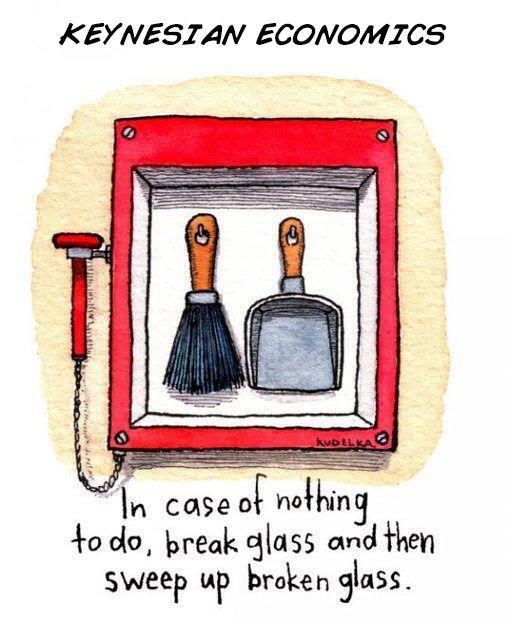
For naive Keynesians and socialist demagogues, boosting GDP is all that matters. C + I + G is the magic formula, and it doesn't matter how things are split, as long as the total rises. Ghost cities and military campaigns are just as good as fusion reactors, and much easier to deliver.

Monday, 4 June 2012

Peter Schiff on the US recovery

Peter Schiff is unimpressed by the 'recovery' in the US:
From 2008 to 2009 our national GDP (of around $14 trillion) contracted by $212 billion. To prevent any further dips, the government aggressively spent, borrowing heavily to do so. To the relief of just about everyone, these moves did stop the nominal contraction. From 2010 to 2011 the U.S. GDP expanded by $502 billion, and from 2011 to 2012 it added an additional $508 billion. All told, from the end of 2008 the U.S. economy added a cumulative $798 billion in GDP. But those gains came at a very high price.

The combined federal deficits for the same time frame come in at a staggering $4.2 trillion! In 2009 alone the feds chalked up a chart breaking $1.4 trillion in debt (the deficit was a mere $161 billion in 2007). In other words, we borrowed five times more than we grew. This “strategy” for growth is no different from an individual who loses half his income, but continues to spend by running up credit card debt. Could this be described as economic growth?

Thursday, 1 March 2012

30s redux?

You know things are bad when even the thoroughly statist FT runs articles like this:

there remains considerable faith – even, or perhaps especially, among people who hate bankers – that a financial solution, involving firewalls, bazookas, leverage and improbable amounts of money, can “solve” the euro crisis. It can do no such thing. It can buy time, as the European Central Banks’s deftly enormous interventions are doing by flooding the banking system with cash – but the purchase of time is not costless.

Thursday, 19 January 2012

Hannan on capitalism and ethics

Another good article from Daniel Hannan:

In an open market based on property rights and free contract, you become wealthy by offering an honest service to others. I am typing these words on a machine developed by the late Steve Jobs. He gained from the exchange (adding fractionally to his net wealth) and so did I (adding to my convenience).

Under the various forms of corporatism tried by fascist and socialist regimes, by contrast, someone else – generally a state official – gets to allocate the goodies, guaranteeing favouritism and corruption.

That’s not to say, of course, that malpractice is unknown in capitalism. Man is fallen and, under any system, some will give in to temptation. It’s just that in a state-run economy, corruption is systemic and semi-legal. Indeed, the most egregious forms of wrongdoing in our existing Western economies tend to be the ones that involve governments: lobbying for improper favours, securing taxpayer bailouts and the like.

He goes on to consider the moralistic hypocrisy of the Left, epitomised by their generosity with other people's money:

I have told the story before of how MEPs reacted to the Indian Ocean tsunami. Speaker after speaker rose to propose gazillions in aid. But when one old boy, a sweet-natured Italian Catholic, rose to suggest that we make a personal gesture by donating a single day’s attendance allowance, the warmth drained from the room. Those who had been promising vast sums on behalf of their constituents glowered sullenly at the poor fellow. His proposal was icily dismissed and the meeting moved on.

Nor does this double-standard apply only to governments. It is equally true of ‘corporate social responsibility’. When you boil it down, this too means being generous with someone else’s money. Businessmen get to feel good about themselves while loading the costs on to their shareholders, their clients and their suppliers. Wouldn’t it be far better if they openly set out to maximise their profits, and then chose, as individuals, to give a chunk away?

It can’t be repeated too often: when you give to good causes, you are making a moral choice. When the government takes an equivalent sum from you in taxation and spends it on your behalf, you are not. This is not to say that all taxation is wrong: some things need to be paid for collectively. But the argument for state involvement is a practical, not an ethical, one.

I recommend the whole article.

Sunday, 15 January 2012

Obama to shrink government?

BBC News reports

US President Barack Obama has laid down the gauntlet to Republicans by asking Congress for the power to shrink the federal government.

He told business leaders that he wants to close the US commerce department and merge six agencies.

The White House said the plan would save $3bn (£2bn) over 10 years and cut 1,000 to 2,000 jobs through attrition.

The proposal is seen as an attempt to counter Republican criticisms that Mr Obama is a big-government liberal.

Let's put that in context. $3bn over 10 years is $300 million a year. That's a lot of money to you and me, and I'm sure it would be a good idea for those savings to be made. But every year American government agencies spend $6 trillion (6000 billion; 6 million million).

What's 300 next to 6 million? The proposed savings amount to 0.005% of total expenditure. Is this really newsworthy? If it's truly an attempt "to counter Republican criticisms that Mr Obama is a big-government liberal", is it anything but laughable? Can the insignificance of this proposal really be lost on the journalists and editors at the BBC?


Some of that spending is out of Obama's control, but the federal government burns through over half of the total: $3.52 trillion in 2009:

300 out of 3.52 million is still utterly insignficant: less than 0.01%. In failing to point this out, BBC News is either grossly incompetent, or staggeringly disingenuous.

Let's have a look at US public spending in a historical context :


The various levels of government in the US spend over 5 times as much today, in real terms, as they did in 1965.

Federal government spending leapt from 523.18 billion 2005$ in 1960 to $3193.90 billion 2005$ in 2011 — a 6-fold increase in real terms.


Anyone who was truly serious about cutting the size of the federal government would be talking about trillions, not billions or millions.

Saturday, 14 January 2012

Public or private downgrade

According to BBC News,

The cut in the so-called sovereign ratings of governments is likely to lead to most other borrowers domiciled in the same countries - including banks and companies - being downgraded.

Although the move has been widely expected, it is still likely to make it somewhat more difficult and expensive for borrowers from those countries to raise money, including for the governments themselves.

Is this true? And if so, how does it work?

Why should the creditworthiness of individuals and private companies be connected to that of governments?

I can only assume that it's a feature of our corrupt caricature of capitalism. If the government struggles to borrow, it will struggle to spend, which may impact company profits and personal incomes. And in extremis, a government that struggles to borrow will have a harder time bailing people out.

I can imagine something similar happening in the private sector. If the economy in a certain town is heavily reliant on a single company or industry, the prosperity of the residents, and their creditworthiness, is tied up with the viability of the dominant employer. If the industry goes pop, a thriving community may turn into a ghost town, with various bankruptcies and foreclosures along the way.

The problem, then, is twofold:
  1. All sectors of our economy - household, corporate, and government - are overly reliant on credit
  2. Governments, over the course of the last century, have become the biggest of big players.

If we are to achieve stability and prosperity, we need to kick our addiction to cheap credit and government pork.

UPDATE

It occurs to me that there may be another factor at work: psychological inertia. The long-standing wisdom has been that government debt is safer than other forms. Why risk your money with competing entrepreneurs, when you can invest in an organisation that confiscates the profits of the winners? What's happening with these downgrades is an overdue recognition that government debt isn't as safe as previously thought. But it could be that investors haven't yet re-evaluated their standing rule that government debts are safer than private debts. Or perhaps some have, but they are basing their choices on the path of the herd.

Friday, 13 January 2012

France downgraded

Long expected, finally delivered:


To be sure, France is in trouble, but fundamentally it is not in much worse shape than your average western welfare state.

Quite why anyone puts stock in the word of these agencies, who famously failed to predict the recent crash, I'm not sure. I expect it has something to do with one of the few sensible points made by John Maynard Keynes:
“It is not a case of choosing those [faces] that, to the best of one’s judgment, are really the prettiest, nor even those that average opinion genuinely thinks the prettiest. We have reached the third degree where we devote our intelligences to anticipating what average opinion expects the average opinion to be. And there are some, I believe, who practice the fourth, fifth and higher degrees.” (Keynes, General Theory of Employment Interest and Money, 1936).
No sane investor can trust the word of S&P, but it seems that enough believe that other investors believe in the worth of their ratings.

How our grandchildren will look back, and laugh.

Monday, 26 December 2011

The demise of the dollar

BBC News reports:

China and Japan have unveiled plans to promote direct exchange of their currencies in a bid to cut costs for companies and boost bilateral trade.

The deal will allow firms to convert the Chinese and Japanese currencies directly into each other.

Currently businesses in both countries need to buy US dollars before converting them into the desired currency, adding extra costs.

It's surprising that it's taken them this long.

The dollar-centric monetary order that has prevailed since WWII is collapsing, and good riddance.

The prosperity of billions of people will depend on what replaces it.

Saturday, 24 December 2011

What's half a trillion between friends?

Daniel Hannan writes:
I'm not sure people have grasped the magnitude of what has just happened. The European Central Bank firehosed €489,190,000,000 at the eurozone banking system. Five-hundred-and-twenty-three banks snatched greedily at the cheap cash.
...
the ECB is hoping that banks will buy government debt with it – as, indeed, they are more or less obliged to do under the Basel III rules. So eurozone governments are borrowing money to lend to private banks to lend to, er, eurozone governments.
It's a collosal sum, especially for an ostensibly conservative central bank.

Detlev Schlichter has more:

The pathetic state of the global financial system was again on display this week. Stocks around the world go up when a major central bank pumps money into the financial system. They go down when the flow of money slows and when the intoxicating influence of the latest money injection wears off. Can anybody really take this seriously?

On Tuesday, the prospect of another gigantic cash infusion from the ECB’s printing press into Europe’s banking sector, which is in large part terminally ill but institutionally protected from dying, was enough to trigger the established Pavlovian reflexes among portfolio managers and traders.

None of this has anything to do with capitalism properly understood.
Quite.

The UK's 950% debt-to-GDP

An interesting perspective from Tyler Durden at ZeroHedge (H/T Andy Duncan):
While certainly humorous, entertaining and very, very childish, the recent war of words between France and Britain has the potential to become the worst thing to ever happen to Europe. Actually, make that the world and modern civilization. Why? Because while we sympathize with England, and are stunned by the immature petulant response from France and its head banker Christian Noyer to the threat of an imminent S&P downgrade of its overblown AAA rating, the truth is that France is actually 100% correct in telling the world to shift its attention from France and to Britain. So why is this bad. Because as the chart below shows, if there is anything the global financial system needs, is for the rating agencies, bond vigilantes, and lastly, general public itself, to realize that the UK's consolidated debt (non-financial, financial, government and household) to GDP is... just under 1000%. That's right: the UK debt, when one adds to its more tenable sovereign debt tranche all the other debt carried on UK books (and thus making the transfer of private debt to the public balance sheet impossible), is nearly ten times greater than the country's GDP
The figure apparently comes from Morgan Stanley Research:

Our official public debt is understated, and I'm not sure what assumptions go into the figures above, but even the BBC's Robert Peston [1] recently declared that the UK's debts are the biggest in the world:
At the beginning of 2010, I highlighted a fascinating analysis by the consultants McKinsey called Debt and Deleveraging, which showed quite how indebted the economies of the developed west had become.

McKinsey said that the UK had by 2008 become the most indebted of all the big, rich economies, more indebted even than debt-engulfed Japan.

It has now become widely recognised that perhaps the greatest economic policy failure in the UK, US and eurozone during the 16 boom years before the crash of 2008 was the explosion of borrowing by banks, households, businesses and governments - or, to use the jargon, the unprecedented and massive leveraging up of entire economies
Peston highlights the findings of a more recent McKinsey report:
According to the consulting firm, by the end of March this year, the aggregate indebtedness of the UK - that's the sum of household debts, company debts, government debts and bank debts - had risen to 492% of GDP, or almost five times the value of everything we produce in a single year.

That compares with 481% at the end of 2008.

So the UK's total indebtedness has increased, and is still the biggest relative to GDP of any of the big economies. That said, Japanese indebtedness is pretty much the same size - at the end of 2010, as opposed to the end of March 2011, Mckinsey says Japan's debts were also 492% of GDP.
Whether you believe the McKinsey figures, or the Morgan Stanley ones, things are looking very bad for the UK.

Durden concludes:
To call that "game over" is an insult to game overs everywhere. So here's the bottom line: France should quietly and happily accept a downgrade, because the worst that could happen would be a few big French banks collapsing, and that's it. If, on the other hand, the UK becomes the center of attention (recall this is the same UK that allows unlimited rehypothecation of worthless assets, and the same UK that unleashed the juggernaut known as AIG-FP's Joe Cassano - after all there is a reason why the UK has 600% its GDP in financial liabilities - financial innovation always goes there where it is least regulated), then this island, which far more so than the US is the true center of the global banking ponzi scheme, will suddenly find itself at the mercy of the market. At that point the only question is whether the vigilantes will dare to take down the UK, as said take down will result in an implosion in the very fabric of modern finance, much more so than what even a full collapse of France could ever achieve, or if due to the certain Mutual Assured Destruction that would follow a coordinated UK onslaught, the market will simply very quietly proceed to ignore the elephant in the room.
Apocalyptic!

I couldn't say whether Durden is right about the UK's supreme position in the "global banking ponzi scheme" (it seems more likely that the Americans pull the strings), but the global monetary and banking system certainly is rotten, and our financial services sector is disproportionately large.

Our best bet is to embrace default. Our politicians may push us to hyperinflation instead.

Let us hope we see more sanity in 2012 than 2011.


[1] Peston sometimes highlights the right issues, but he's far too corrupted by Keynesian thinking. That same BBC article includes the following gem: "To be clear, if governments had not continued to spend, our recession might well have become something much worse, a 1930s-style depression."

Thursday, 1 December 2011

Heath: Media is failing public in many ways

Another excellent article from Allister Heath:

As the ComRes/Institute of Economic Affairs poll points out, the public has got completely the wrong idea about what will be happening to the national debt over the next few years. Because the coalition will be only gradually reducing the budget deficit, the national debt will continue to soar in cash terms and as a share of GDP. An extra £350bn or so will be added to the national debt before the next general election, if all goes according to plan. So far, so self-evident, you may think. Yet the public – primarily because of the way this story has been reported in print, online and in the broadcast media, together with Britain’s appallingly low level of financial literacy – has no idea whatsoever about this. It wrongly thinks that the coalition is planning to “repay our debt” – and fails to grasp the key conceptual difference between the annual deficit (or extra debt) and the outstanding total national debt (a stock which keeps on growing as long as there is a deficit).

The poll asked whether the coalition would be keeping the national debt the same over the next four years, increasing it by £350bn or cutting it by £350bn. Just nine per cent got it right – 21 per cent thought it would be staying the same and an astonishing 70 per cent thought the national debt would be cut by £350bn. This is an extraordinarily depressing finding and first and foremost a massive failure of journalism. It is also a failure of political communication and of education. Given such catastrophic levels of misunderstanding about what will be happening to the economy over the next few years, how can the public possibly come to a sensible decision about spending choices? It is a bitter blow for democracy and robs the UK of the ability to conduct a sensible, grown-up discussion about what should be done to tax and spend.

It is all the more tragic, seeing as we have a tax-funded broadcaster that claims to offer 'public value':

While commercial broadcasters aim to return value to their shareholders or owners, the BBC exists to create public value. In other words, it aims to serve its audiences not just as consumers, but as members of a wider society, with programmes and services which, while seeking to inform,

educate and entertain audiences, also serve wider public purposes. Public value is a measure of the BBC’s contribution to the quality of life in the UK.

The BBC creates public value in five main ways ...


And the very first of these?
Democratic value: the BBC supports civic life and national debate by providing trusted and impartial news and information that helps citizens make sense of the world and encourages them to engage with it.
EPIC FAIL.

Sunday, 27 November 2011

Janet Daley: try doing less

Via Westminster's most promising MP, I discovered this Telegraph article by Janet Daley:

Gosh, what a parcel of goodies George Osborne is about to present to us in his Autumn Statement. Already promised last week were a government programme to underwrite the mortgages of first-time buyers, as well as a nifty £200  million “green deal” to encourage families to insulate their homes. Then there was a billion-pound subsidy to employers who give young people work experience that will lead to jobs. And who knows what more bounty is to follow in the speech itself?

Now where have I seen the like of this beneficence before? Oh yes – it was under Gordon Brown. As Chancellor (and then later when he was Prime Minister, through his half-hearted proxy Alistair Darling), Mr Brown would stand at the Dispatch Box and shower us with government spending projects. There were injections of cash into house-building, and grants for scientific research, and God knows how many initiatives to create “training” and engineering apprenticeships. All that micro-management: new “start-up” schemes and “one-stop shop” outreach services funded by this department and that department, and then re-packaged and re-announced so that they sounded less tired and predictable.

Maybe you thought we had got past this. Not just because additional public spending is now supposed to be anathema, but because the myth of government activism – the idea that intervention by the state is the answer to every economic and social problem – had been definitively routed. Apparently not: Mr Osborne and, we must assume, his boss still seem to believe that any unacceptable national situation must require direct action from them.

Very sad.

Friday, 11 November 2011

Has Hannan lost the plot?

Daniel Hannan is generally sound, but he seems to be periodically afflicted by conventional wisdom. His latest article for the Daily Mail is a case in point.

I replied on his Telegraph Blogs site as follows:
"A default by Rome, on the other hand, would blow the European economy to smithereens."

Would it?

Certainly, those who were foolish enough to lend to the Italian government would lose out, but I don't see why the wider economy should suffer.

"Since no one would then lend it money,
it would have to print lots of lira very quickly to pay the salaries of
its soldiers, policemen and other vital public servants."


Has someone got to you, Daniel? Do you really believe that there is no fat left to be trimmed in the Italian public sector? Surely they could balance the budget without impacting any genuinely vital services.
Italy should embrace default. So should we all.

Tuesday, 8 November 2011

Allister Heath on Communism

Another good article form Allister Heath:
Communism has been tried repeatedly. It doesn’t work. Most people just about remember this (though most youngsters will have forgotten by the time the next crisis comes about). Communism’s degree of failure is utterly incomparable with the failure of our present, mixed economy system (what we have is not pure capitalism or “neo-liberalism” but a weird and unstable combination of markets combined with a large public sector, high and graduated taxes, hugely powerful monetary authorities and a huge amount of regulation). Communism leads to collapse, starvation and dictatorship.
Heath provides plenty of examples, and recommends The Black Book of Communism: Crimes, Terror, Repression, which "details how at least 94m people lost their lives as a result of communism in the twentieth century".

But what of those compliant comrades who weren't forced to pay the ultimate price? Is there nothing to recommend the communist approach?
Two natural experiments were run last century: an unusually pure version of capitalism in Hong Kong versus real communism in China; a slightly more diluted but still highly capitalist model in post-war Germany versus a socialist system in East Germany. In both cases the triumph of capitalism was complete.
Heath concludes:
Instead of wasting time investigating the views of an economist whose overall system failed disastrously, we should be learning from those who understand that a free-market is the only possible system but who also grasp that current institutions tend to lead to booms and busts, especially if the price system is distorted by underpriced credit or underpriced risk as a result of central bank or government actions. If you are into dead economists, try reading Ludwig von Mises or F.A. Hayek. The latter predicted the crash of 1929 and the stagflation of the 1970s; their followers predicted the dot.com bubble and the collapse of 2008. Marx should remain buried.
It is a good point, well made.

Cameron the money printer

The Telegraph reports:

Mr Cameron is thought to be in support of a plan for the European Central Bank effectively to print money in a Continent-wide quantitative easing programme which could be used to rescue Italy and possibly Spain. The ECB is heavily dependent on German financing but Angela Merkel, the German Chancellor, has refused to support the bank playing a central role in a eurozone bailout package because of fears that it will cause high inflation.

It is the first time that the Prime Minister has publicly expressed his anger at Germany for blocking a deal involving the ECB.

Massive money printing: what could possibly go wrong?

It's as if the Germans have past experience of this ...

HS2

BBC News:
The case for HS2 depends partly on the idea that time spent on the train is unproductive, so that if you can make the journey shorter there will be big productivity gains for the economy.

The government document setting out the cost/benefit analysis puts the value of that time saving at £7.3bn by 2043 - and that's just for the section running from London to Birmingham.

But when I got on a train at Birmingham International, I found plenty of passengers - in First Class at least - who appeared to disprove that theory.

With free wi-fi on the train, they were hunched over their laptops and smartphones, busy working rather than idling away the journey.
What do the passengers think?
If the HS2 project does go ahead the journey to London will be cut to just 49 minutes by 2026.

But the passengers I met did not seem too excited by that - Roisif Wilson, who spends some of the week shuttling between offices in Birmingham, was not convinced that the money would be well spent.

"We use the internet for conference calls anyway," she said. "We're living in a much more technological age and I think it would be good to invest in better wi-fi for more people. It's not a significant enough difference for the investment."
Personally, it strikes me as a grotesque waste of money. They should concentrate instead on getting our existing trains to run on time, and adding capacity so that people don't need to stand.

UPDATE:

Here's the latest from Westminster's most promising MP:
The Transport Committee’s report into High Speed Rail was released today. You can find it here.

I voted against the report. In my view, it is too supportive of the present proposals.

In committee, a number of us brought forward and voted for amendments which would have softened the report substantially. Some of these were defeated by just one vote. Full details can be found in the formal minutes at the end of the first volume.

Sunday, 6 November 2011

More subsidy, Gromit?

BBC News reports
Wallace and Gromit maker Aardman's head of TV has said the company may have to halt UK production of its famed stop-frame animations because it has become too expensive.
...
The main problem, he said, was that while films made in the UK can receive government help in the shape of a 15-20% tax credit, UK TV animation receives nothing.
The right answer, of course, is to do away with all tax credits, while reducing corporation tax across the board (preferably to zero).

The government shouldn't be picking winners. The best thing it can do is to get out of the way, and leave Britons to figure out what they're best at.

Besides reducing or abolishing corporation tax, there are a number of things the government could do to make British businesses more competitive internationally, without favouring one region or industry over another:
  • Abolish minimum wage (the government shouldn't condemn people to unemployment just because their labour is worth less than some arbitrary, centrally planned amount)
  • Repeal labour laws (both sides of an employment contract should be voluntary, and the terms should be decided by the employer and employee, not bureaucrats)
  • Abolish employers' national insurance (the last thing we should be doing at the moment is discouraging job creation)
  • Merge employees' national insurance with income tax (that's what it effectively is anyway), and make rates low and flat (so that there is never a disincentive to work)
  • Abolish Capital Gains Tax (we should not be discouraging investment)
  • Reduce welfare handouts to the absolute minimum (hostels and soup kitchens) so that everyone who can work, seeks work
  • Abolish all carbon taxes (if this seems radical, read 'An Appeal to Reason')
  • Exit the EU (so we can trade freely with all countries of the world, rather than just Europe)