Showing posts with label eu. Show all posts

Wednesday, 23 January 2013

Cameron's EU speech

Cameron's speech on the EU was well-crafted, and contained many good points.

Nobody can reasonably argue that we should do less than what he has proposed.

The problem, of course, is that he did not go far enough.

There's going to be a flood of commentary over the next few hours and days, and I'll try to find time to blog about some of it, but I largely agree with Tim Aker of the Get Britain Out campaign, who was quick off the mark with an email (sent this morning at 8:52):

As anticipated, David Cameron has let the British people down by avoiding the best option for our country. All the polls indicate a majority of the Great British Public want an EU Referendum. The people of our country, however, must be given an In/Out referendum before the next General Election.

Sadly the Prime Minister is showing he is motivated only by power and politics rather than the welfare of the British people. His actions speak louder than words. The cast iron guarantee on a Lisbon Treaty referendum proved rusty. He ordered a 3 line whip against an EU vote earlier in this parliament. He could easily order a 3 line whip for an EU referendum before the election. Like Tony Blair on Iraq, David Cameron has trust issues on the EU. Cameron’s option to wait after the next election, to offer a weak tinkering of our EU membership is unacceptable.
...
Years of renegotiation will solve little and cost British taxpayers over £80 billion in membership contributions between now and 2017. In any case, it will not work because other EU member states have already informed the Prime Minister they will not accept his proposals. Our government will squander even more British taxpayers’ money trying to turn the EU into something it is not.

The EU is only going one way. The current solutions to the economic crisis in the European Parliament and Commission will involve even more integration. Banking and Fiscal Union will be complete by 2017. Article 16 of the Fiscal Compact incorporates Fiscal Union into EU law by 2017 at the latest. We have no choice. We are bound by EU laws, rules, regulations and Directives while we remain inside. There is nothing to stop a future government taking Britain into Fiscal Union.
...
Get Britain Out unswervingly calls for an In/Out EU Referendum now, to leave us free to govern our own country without EU interference, and arrange our own simple trading relationships as we thought we had when we joined the ‘Common Market’ in 1972.

The only possible argument against a referendum in this parliament is that we might lose it. There are a great many people who don't yet see the EU for what it is, and many more who have some concerns, but would be easily swayed by the powerful forces that will campaign for us to remain in. We know that the europhiles will shamelessly mislead the public, with disingenuous arguments and half-truths, if not outright lies. They will try to scare the masses into accepting the status quo, and they might well succeed. Perhaps things need to get much worse before we can be assured that the public will vote out.

Cameron's speech gave a taste of the specious arguments that will be employed. He pretended that we have influence within Europe, in the face of all the historical evidence. He claimed that we have repatriated powers when in fact we have managed only to resist some of the more egregious EU power grabs. He stressed the importance of a hazily-defined 'common market', when what we really need is a free trade area, not a customs union. As Europe's share of global GDP declines, we need free trade with Europe and the rest of the world, not protectionism elevated to the continental level.

There is a risk, of course, that we'll never be given a choice. Or that referendum day will be delayed until the indoctrination of the British public is complete, or until the results can be rigged. Or that by the time we finally choose to leave, the EU will be strong enough militarily to prevent our secession, just as the Union army of Abraham Lincoln used deadly force to deny the Confederates their right to democratic self-determination.

I'd love to know what David Cameron really believes, deep down. I wonder if we'll ever know.

Monday, 21 January 2013

EU tyre labelling

Last Wednesday I finally got some winter tyres fitted, just in time for the recent snow.

In choosing the tyres, I did what most people do: I read some reviews, and I satisficed. I decided I was happy enough with the Michelin Alpin A4s available from KwikFit, and I booked my appointment. So far they're serving me well.

At no point in this process did I feel the need for guidance from the EU. But someone in Brussels has declared 'market failure' and sought to address it:


European Regulation No 1222/2009 came into force from 1st November 2012. Apparently my lovely new tyres have an 'E' rating for fuel efficiency and a 'C' rating for wet grip. Sad, I know, but somehow I'm managing to hold it together.

For those who care about fuel efficiency, engine and driving style are likely to be much more important factors. To the extent that tyres matter, it's probably enough to keep them properly inflated. As for wet grip, without knowing what temperature they performed the test at, I have no idea whether the rating is relevant. I could dig into the details, but life is too short. I suspect this expensive new labelling system will be widely ignored by consumers, just like the energy efficiency ratings for houses.

If the ratings do manage to influence customer behaviour, they may well be nudging people in the wrong direction. Even assuming that their tests are well designed, they focus attention on a narrow range of features and conditions, and discourage critical thought.

Incidentally, there are no prizes for guessing where the BBC stands on this: New European tyre labelling could save money and lives.

And a bit of googling turns up some classic astroturfing. The new EU labels are supported by The Campaign for Better Tyres.


The Campaign for Better Tyres is being co-ordinated by Environmental Protection UK (EPUK), a national charity that provides expert policy analysis and advice on air quality, land quality, waste, noise and climate change.

Environmental Protection UK was one of a consortium of NGO’s which lobbied for the introduction of the new EU tyre legislation, which sets stricter standards for tyres on energy efficiency, noise and safety and introduces mandatory tyre labelling.

The campaign has been funded with a grant from the Esmée Fairbairn Foundation, with additional financial support from the European Federation for Transport & Environment.

And what about EPUK? A group of concerned citizens devoting their own money to an important cause? It seems not:


The UK's oldest environmental NGO has been forced to close after government cuts to local authority budgets drastically reduced its income.

Amazing. A non-governmental organisation entirely reliant on government funding. Sorry to see them go.

An EU referendum in this parliament?

Cameron must have been glad for the Algerian distraction. Waging the War on Terror is presumably much more fun than fighting your own back-benchers.

Although I'm looking forward to his speech, I don't have high hopes. Daniel Hannan wrote a piece in defence of the PM last week:

At this stage, several of my regular commenters will say "Ah, but a referendum is worthless unless it takes place in this Parliament". Well, OK, chaps. If you have a way to make Labour and LibDem MPs vote for one, I'm all ears. But if you haven't, it's really a bit much to blame the Tories for how the other parties vote.

But we all know that Dave can't be trusted. If he's serious about a referendum, it would seem sensible to at least try for one ahead of the general election, as I noted in the comments:

Easy. Cameron says that he would like the referendum to take place in this parliament, he whips his party into supporting that, and he dares Labour and the Lib Dems to vote against. If they succeed in crushing the proposal, they look bad, and he can honestly say that he tried.

Monday, 14 January 2013

Another victory for protectionism

Another story from BBC News:

Sweden has issued international arrest warrants for two Britons suspected of illegally importing 10m euros (£8m) worth of garlic into the EU via Norway. Why would criminals do that?

Why indeed?

The answer:

  • EU imposes 9.6% customs duty on foreign garlic
  • China produces about 80% of the world's garlic, cheaply
  • Criminals can make millions of euros smuggling it

...
[The customs duty] was meant to prevent garlic growers in EU member states from being driven out of business by Chinese farmers, who have captured large swathes of the global market by producing crops at knock down prices.
...
Garlic in the EU is mainly produced in Spain, but also in Italy, France, Poland, Hungary, Romania and Bulgaria.

If you're a continental garlic farmer, the EU is brilliant. For the rest of us, not so much - we're forced to pay more for our garlic. The same applies for countless other goods. The CAP represents the triumph of producers over consumers.

I wish the Eurocrats would read some Bastiat. But since they won't, we really need to Get Britain Out - the sooner, the better.

Saturday, 12 January 2013

Auntie says: stay in the EU!

Three EU articles were featured on the BBC News front page this morning.


German MPs warn UK EU exit would be 'economic disaster'


EU debate: Conservative MEP deplores 'pitbull UK' image


Lord Heseltine attacks David Cameron's EU strategy


An EU exit would be an 'ill advised' 'economic disaster' with an 'unknown outcome'.  It would be 'a gamble', 'a punt', and would 'drive away inward investment'.  The EU 'makes the UK more valuable to the US'.  And besides, 'strident Euroscepticism' is 'pretty darned unattractive'.

This is neutrality, BBC style.

Thursday, 10 January 2013

Depardieu defects

Through Andy Duncan's blog, I discovered a great article by Jeff Berwick on Gérard Depardieu's 'defection' to Russia. As Andy points out, we're unlikely to hear that word used in the mainstream media, but it seems to fit.

If I had told you twenty years ago that the rich of the West would have to flee to Russia for economic freedom, you might have slapped me for lying.

But that is exactly what is going on today as Western governments get increasingly brazen about their true kleptocratic natures, seeking to “expropriate the expropriators” in order to save their unsustainable welfare (European) and warfare (American) states.

Europe has never been the land of economic freedom, but it wasn't as bad as the Communist states of the USSR which kept roughly 100 percent of their citizens' income, a condition commonly known as slavery. Before the fall of Communism, people were actually risking their lives trying to escape places like Russia and East Germany. Now as Russia moves away from economic slavery toward economic freedom and Western Europe takes giant steps toward communism, the rich of the West are both the first targets—and the first escapees.

What I can't understand is why David Cameron isn't keen to welcome all of these rich refugees. Why not offer a low, flat income tax here in Britain? It wouldn't need to be as low as Russia's (reportedly 13%), because London is still a more attractive destination for most people than Moscow.

We could also abolish corporation tax, so that major corporations use us as their European headquarters instead of Ireland.

At the same time, rich Britons wouldn't waste their time contemplating tax avoidance and emigration.

We could do all of this while remaining in the EU. Indeed, we could exploit the free movement of people and capital to attract the right sort of Europeans to our shores - the kind who wouldn't put any strain on 'resources'.

In short, why aren't we a tax haven?

Wednesday, 9 January 2013

A European health initiative

Your local medical centre is always a rich source of government propaganda, and I noticed some fine examples the other day, but this one stood out from the rest:


Did you know that the EU had assumed responsibility for our health?

I blogged about EuroNannying back in 2011. A quick visit to europa.eu shows that the Eurocrats are still expressing great concern for our youth:


They're looking after us grown-ups too, protecting us from harm-reduction products like e-cigarrettes and snus ('quit or die' seems to be their preferred approach, though in practice they're quite happy for you to be forever dependent on nicotine gums and patches, the officially sanctioned solution from Big Pharma):


[As ever, Christopher Snowdon's blog is the best to follow for such matters]

In typical style, EU ambitions in the field of public health are proudly displayed for all to see:
The Health and Consumers Directorate-General is pleased to present the Health-EU Portal (the official public health portal of the European Union) and the wide range of information and data on health-related issues and activities at both European and international level. The main objective of this thematic Portal is to provide European citizens with easy access to comprehensive information on Public Health initiatives and programmes at EU level. The portal is intended to help meet EU objectives in the Public Health field, it is an important instrument to positively influence behaviour and promote the steady improvement of public health in the 27 EU Member States.
...
The Portal is an initiative of the Community Public Health Programme 2003-2008 intended to permit greater involvement of individuals, institutions, associations, organisations and bodies in the health sector by facilitating consultation and participation. In this framework, attention is given to the right of the EU population to receive simple, clear and scientifically sound information about measures to protect health and prevent diseases. One of the main aims of the portal is to convey that citizens share responsibility for improving their health. Increased awareness of the different EU activities and programmes relating to Public Health will help the general public contribute to and support them.

The Policy is further explained on the page linked above:

The EU is required by its founding treaty to ensure that human health is protected as part of all its policies, and to work with the EU countries to improve public health, prevent human illness and eliminate sources of danger to physical and mental health.

The EU's strategy for protecting and improving human health is chiefly implemented by the health programme. It is one of several programmes to implement health policy at EU level.

The EU is a danger to my mental health and I hereby request that they disband forthwith. More likely, I'll find myself on somebody's list, to be locked away with all the other lunatics. What else but mental illness could explain such phenomena as 'climate change denial' ...

Sunday, 30 December 2012

The EU-funded Duchess

There's plenty of serious stuff on my list of things to blog about, but I can't really face it, so here goes ...

Last night I saw The Duchess for the second time. And I confess that for the second time, I enjoyed it. I guess I'm a sucker for period dramas.

There was a sinister surprise in the credits, though.  Apparently the film had been funded by the EU's "MEDIA film support programme". A 2009 article on their website proudly elaborates:
Seven films funded by the EU's MEDIA film support programme have been nominated for Oscars at this year's Academy Awards: Der Baader Meinhof Komplex (Germany, Uli Edel), Entre les murs (France, Laurent Cantet), Waltz with Bashir (Israel/France/Germany, Ari Folman), Happy Go Lucky (UK/Mike Leigh), The Duchess (UK/France/Italy, Saul Dibb), Slumdog Millionaire (UK/US, Danny Boyle) and the award-winning documentary, Man on Wire (UK/US, James Marsh) (for synopses, see annex).

The EU's MEDIA programme provided significant financial support to these films figuring high on the nominations list of the Oscars Ceremony. The total contribution from the EU's MEDIA programme for these films alone amounted to € 3,028,000, with even more support likely to follow for distributing the film to cinemas.
It's been running for a while ...
The MEDIA 2007 programme will provide €755 million to Europe's film industry from 2007-2013 (IP/07/169). This January the Commission also proposed a MEDIA MUNDUS programme (IP/09/26) that will provide another €15 million of funding from 2011-2013 for projects submitted by audiovisual professionals from the EU and third countries. A clear priority of both the MEDIA and the MEDIA MUNDUS programme is the distribution and promotion of European films outside their original country, across Europe (almost 65% of the total MEDIA budget) and the globe.

The MEDIA programme's overall objectives are to strengthen the competitiveness of the European audiovisual sector by facilitating access to financing and promoting use of digital technologies, to reflect and respect Europe’s cultural identity and heritage, and to increase the circulation of European audiovisual works inside and outside the European. In 2008 the MEDIA programme supported over 1,800 projects with a total €107 million.
Few things are more subtly sinister than government meddling in 'cultural identity'.

Both times I watched this particular film, I watched it uncritically, for escapism and eye candy, but perhaps it's worth revisiting.

There are two main themes in The Duchess: men had extreme and unjust power over women in the 18th century, and the aristocracy likewise had unreasonable and unsustainable power over the ordinary man.

As a libertarian, I don't really dispute either of these points. But I can't resist a couple of observations.

Whereas men once had significant state-granted power over women, the pendulum has swung back the other way. Men and women are not legally equal. Women are entitled to generous maternity benefits. They benefit from positive discrimination in the form of diversity quotas. They fare unreasonably well in custody and divorce settlement decisions, and they are granted absolute power over the lives of unborn children.

If a man gets a woman pregnant, and decides that it would be better to abort the child, he is powerless. He's not even free to walk away. He will be held financially accountable for many years to come.

By contrast, a woman can choose to terminate the pregnancy - to take the life of an innocent proto-human - even if the father is willing and able to take on sole responsibility for raising the child. How do 9 months of discomfort, and a few hours of extreme discomfort, compare with 18 years of financial enslavement?

Of course, I feel that fathers ought to care for their children. I am a father myself. And I don't believe that abortion should be illegal (though he case for state subsidised abortions is questionable).  But there is no disputing the fact that women today are in a legally favourable position. Do we really need to keep harping on about past injustices? A certain group of EU bureaucrats with their hands on your money think so.

Then there's the question of the aristocracy. Despite all their anti-democratic moves, the EU would have you believe that democracy is an unalloyed good. They pay lip service to this grand ideal, which supposedly prevents exploitation.  But look at what's happened to individual liberty as suffrage has widened, eventually becoming universal.

I haven't yet read Hoppe's Democracy: The God That Failed, and for now I'm still inclined to think democracy is the least bad option, but the tyranny of the majority does not deserve to be celebrated.

Wednesday, 31 October 2012

A small step in the right direction

A tiny bit of good news:

The rebel amendment calling for a real-terms reduction in EU spending was passed after a stormy debate in Commons on the 27-member union's next seven-year budget and UK contributions.

Westminster's most promising MP posted a good article on the subject earlier today:

Only two areas were ringfenced from the current spending cuts: the NHS and foreign aid. The EU is not on the list. Why should it not take its share of austerity? Let’s not forget that because Britain’s public finances are in deficit (thanks to Labour), we borrow and pay interest on the money we give to the EU every year.

After years of rolling over for the EU while in government, the Labour Party are saying they will vote for the reduction. There’s a whiff of opportunism in the air. Knowing that the Coalition could be defeated, no Conservative will enjoy going through the lobby with the spendthrift authors of Britain’s present financial misery. Nevertheless on this occasion Labour are – even if for the wrong reason – helping the Prime Minister. The stronger his parliamentary mandate to demand the EU takes a cut, the stronger his credibility will be at the negotiating table. Other Governments will know the PM cannot deliver a Commons’ majority for a bad deal in the way Balir regularly did.

Labour's opportunism is truly shameless, but on this occasion I'm happy to see them do the right thing for the wrong reason, and it was heartening to see enough Conservative backbenchers put country before party (many of them, I'm sure, for opportunistic reasons of their own).

What's truly shocking is that there are some MPs prepared to oppose a real-terms cut in the EU budget, but at least things seem to be moving in the right direction.

UPDATE


Here's Daniel Hannan's summary of the event:

For the first time since Britain joined the EU, Parliament has voted in an unequivocally anti-Brussels manner. It won't do to say that Labour's vote was meaningless because its motive was cynical. Of course it was cynical, but so what? The fact is that the party will now find it awkward to back away from its new and popular position on EU spending. Public opinion long since hardened against the EU; parliamentary opinion has at last followed.

Congratulations to Mark Reckless, who has the distinction of being the first MP in 40 years to secure a Eurosceptic majority in the lobbies. Congratulations, too, to all those parliamentarians who did as their electors wanted, on both sides of the chamber – but particularly to those put their constituents before their Whips. The 53 Tory heroes are listed here. Ladies and gentlemen, you are honourable members indeed.

Wednesday, 25 July 2012

Fit to drive?

The Telegraph reports:
Drivers will have to declare every 10 years whether they are medically able to get behind the wheel, according to proposals to be set out early in the new year.

For the first time, the Driver and Vehicle Licensing Agency (DVLA) will issue a series of minimum physical and mental requirements motorists must fulfil including eyesight performance and reaction times.

Tests, costing up to £80, will be offered to drivers to check whether they are fit to drive.

Anyone who chooses not to take the tests but declares themselves able to take to the roads will be committing a criminal offence if they fail to meet the established standards.

Pass your test at 17. Waste money and time at 27, 37, 47, and probably 57. Fail to comply, and you risk a criminal record, even if nobody has been harmed.

I'm all for ensuring people are fit to drive, and as long as the roads are public, it is natural for this responsibility to fall to government.

But I can't help but think that the imposition on younger drivers is calculated to avoid charges of "age discrimination". And though it's not mentioned anywhere in the article, I wonder if there's an EU angle to this.

EU-inspired or not, there does seem to be something sinister about it, as Tom Paine explains:

I have absolutely no desire to survive my driving licence. Life without driving a car is unthinkable to me. It's bad enough that the government claims the right to decide who may operate this particular type of machine at all, but imagine the scope this will give the nanny statists given their constant redefinition of the word "health".

Do you drink more than their made-up safe limit per week? Do you smoke? Are you (like most of the England rugby team) in excess of their stupid BMI ratio? Do you believe the British state your greatest foe? You are clearly unhealthy in body, mind or both.

Of course, just because life for Tom is unthinkable without driving, it doesn't follow that he should be allowed to drive, regardless of circumstances. But proactive, preventative measures are always prone to abuse. We should be wary of victimless crimes. And we know that, in the absence of competitive pressures, the nanny statists always err on the side of caution. Just look at Oxford's ridiculous 20 limits.

Aside from the potential for inappropriate redefinition of 'health', there is the prospect of a shortened inspection interval. If checks every 10 years are a good idea, why not every 5? We are already forced to have health checks for our cars every year, so why not have a yearly 'MOT' for the driver? We can't discriminate based on age, of course, so this would apply to all of us. What a wonderfully docile people we'll be when we regularly submit ourselves for approval by government functionaries.

Recall the words of A J P Taylor:
Until August 1914 a sensible, law-abiding Englishman could pass through life and hardly notice the existence of the state, beyond the post office and the policeman.

Do no wrong, and you will be left alone - your personal responsibility and good intentions will be assumed, until there is cause to doubt them. A country of grown-ups, getting on with their lives. How far we've come.

UPDATE

It turns out the Telegraph article was from 2008. I'd like to think that the idea died with New Labour, but I'm sure it's sitting in a drawer somewhere, waiting to be resurrected by our Glorious Coalition (aka Continuity NuLab).

As for the EU connection, a bit of googling turned up this from 2003:
The European Commission has put forward a proposal to amend the existing Directive on driving licences (91/439/EC) which would mean that it would be mandatory for driving licences to be renewed every 10 years. At present the majority of countries either have no time limit (Austria, Belgium and Germany) or a set time limit (eg: up to 70 years of age in the UK).

By 2008, the 10 year renewal requirement was reported without a hint of EU involvement:
The Department for Transport hopes to use the introduction of photocard licences, which will need to be renewed every 10 years, to change the system.

Wikipedia has more about European Driving Licences:
In March 2006, the Council of Ministers adopted a Directive proposed by the European Commission to create a single European driving licence to replace the 110 different models currently in existence throughout the EU.
...
Some categories like C and D will be issued for five years only. After expiration, a medical check-up is necessary in order to renew the licence for another five years.
...
The directive stipulates that members states should adopt laws implementing the directive no later than 19 January 2011. Those laws should take effect in all EU members states on 19 January 2013. All licences issued before that date will become invalid by 2033.

It might seem reasonable for lorry and bus drivers to have health checks, but it's a slippery slope, and because the rules are handed down by the EU, there is very little we can do to stop them.

Wednesday, 13 June 2012

Quisling Clarke

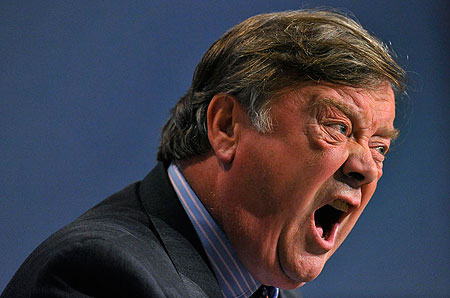
A referendum on our membership of the EU is an irrelevance. It is the demand of a few Right-wing journalists and a few extreme nationalist politicians. I cannot think of anything sillier to do than to hold a referendum.
So said The Rt Hon Kenneth Clarke QC MP on Radio 4 recently, according to an email update from The People's Pledge. They also supplied an amusing photograph:


It's hard to escape the conclusion that Clarke is not simply misguided, but actually a Very Bad Man - England's answer to Vidkun Quisling.

Who but a traitor could dismiss as 'silly' the notion that the British people have a right to democratic self-determination?  Who but a traitor could characterise as 'extreme nationalist' the view that laws affecting the British people should be made in Westminster rather than Brussels?

37 years ago, on the 5th of June 1975, British voters were asked
“Do you think that the United Kingdom should stay in the European Community (The Common Market)?”

Today's EU is far from a simple "common market". Many of those who voted for membership in 1975 have regretted their choice, and nobody under the age of 55 has had any say in the matter. An in-out referendum is long overdue.

Monday, 4 June 2012

The would-be superstate and the ex-superpower


BBC News reports:
EU officials are expected to press Russian President Vladimir Putin to take a stronger line on the crisis in Syria during a summit in St Petersburg.
...
European Council President Herman Van Rompuy, European Commission President Jose Manuel Barroso and EU foreign policy chief Catherine Ashton are among those attending Monday's summit.

On Sunday, Mr Putin invited the EU leaders for dinner ahead of the talks at a lavish estate on the outskirts of the city.
It's bad enough when the likes of William Hague go swanning around, meddling in the affairs of other countries.  But how much worse to have these little-known, unelected eurocrats dining at a lavish estate, purporting to speak for 500 million Europeans!
Baroness Ashton, who met Russian Foreign Minister Sergei Lavrov before Sunday's dinner, said in a statement: "Russia's role is crucial for the success of Annan's plan."

She said the EU wanted to "work closely with Russia to find a way to end the violence".
Who empowered Ashton to speak on our behalf?  Who decided that foreign policy should be handled by the EU?

The British people were denied their say; our Queen signed our sovereignty away.

Posts by Daniel Hannan and Norman Tebbit celebrating the Jubilee have drawn many comments supporting the Queen. They say she has no choice but to sign whatever treaties 'her' government puts before her. At a practical level, this is clearly false - nobody is holding a gun to her head, and she could achieve a great deal by refusing to sign and forcing a referendum. But if, legally, she has no right to refuse, let's end the charade, and have the PM do the signing.

Tuesday, 29 May 2012

Elizabeth the Useless

On the reign of QEII, I find myself agreeing with Sean Gabb:

The motto for Queen Victoria’s Diamond Jubilee was “Sixty Years a Queen.” The motto now might as well be “Sixty Years a Rubber Stamp.” If, during the six decades of her reign, England has been transformed from a great and powerful nation and the classic home of civil liberty into a sinister laughing stock, the ultimate responsibility for all that has gone wrong lies with Elizabeth II.

...

Once the politicians make themselves, as a class, irremovable, and once they begin to abolish the rights of the people, it is the duty of the Monarch to step in and rebalance the Constitution. It is then that she must resume her legal powers and exercise them of her own motion.

The need for this duty to be performed has been apparent since at least 1972, when we were lied into the European Union. The Conservatives did not fight the 1970 general election on any promise that they would take us in. When they did take us in, and when Labour kept us in, we were told that it was nothing more than a trade agreement. It turned out very soon to be a device for the politicians to exercise unaccountable power. The Queen should have acted then. Indeed, she should have acted – if not in the extreme sense, of standing forth as a royal dictator– before 1972. She should have resisted the Offensive Weapons Bill and the Firearms Bill, that effectively abolished our right to keep and bear arms for defence. She should have resisted the Bills that abolished most civil juries and that allowed majority verdicts in criminal trials. She should have resisted the numerous private agreements that made our country into an American satrapy. She should have insisted, every time she met her Prime Minister, on keeping the spirit of our old Constitution. There have been many times since 1972 when she should have acted.

At all times, she could have acted – all the way to sacking the Government and dissolving Parliament – without provoking riots in the street

Gabb concludes:

The Queen has not sustained our national identity. It is actually worse than this. By expressing that identity, she has allowed many people to overlook the structures of absolute and unaccountable power that have grown up during her reign. She has fronted a revolution to dispossess us of our country and of our rights within it. How many of the people who turn out on Jubilee Day, with their union flags and street parties, will fully realise that the forms they are celebrating now contain an alien and utterly malign substance?

...

Sooner or later, the luck of the draw may give us a Patriot King.

As for Her Present Majesty, she may be remembered in the history books as Elizabeth the Useless.

Apart from a gratuitous reference to a "bunch of black Marxists", the article seems spot on.

Many of the events that Gabb refers to were before my time, but I remember the Lisbon Treaty. The public were promised a referendum. The Queen would have lost nothing by insisting on it. Indeed, a substantial portion of the population would have thanked her for standing up to our corrupt politicians. And yet, for reasons unclear, she rubber-stamped that act of treason.

Our Queen has succeeded at many things, and is deservedly well regarded around the world, but she has failed abysmally at her most important task: safeguarding our freedom and sovereignty.


UPDATE


I'm not sure whether to be amused or dismayed by this Radio 5 excerpt, in which the presenter is determined not to engage in any serious discussion of the question "Why should we celebrate the Jubilee?". Classic BBC.

Friday, 18 May 2012

The beginning of the end?

It seems the long-anticipated euro collapse is imminent.

Daniel Hannan explains what the Eurocrats are doing about it:
Greeks are withdrawing 700 million euros a day from their banks. Sixteen Spanish banks have been downgraded by Moody's, raising the prospect of a bank run across the Mediterranean. Barack Obama has joined David Cameron in pleading with eurozone leaders to take action commensurate with the gravity of their predicament.

How is the EU responding? What are the issues at the top of its agenda this week? A financial transactions tax, a common definition of homophobia, new rules on the fishing of bluefin tuna and gender quotas on company boards.

When the world lurches beneath our feet, when old certainties crumble, we often withdraw into the familiar. In their panic, Eurocrats and MEPs have reverted to what comes naturally: proposing more regulation.
I suppose we should be grateful that they're not trying to tackle the serious problems. Their cure would surely be worse than the disease.

Wednesday, 29 February 2012

Who's to blame for the Greek tragedy

I don't ordinarily read The Sun, but I recently followed a retweeted link to a truly absurd article:
Greek diplomat Leonidas Chrysanthopoulos is near tears as he watches neatly dressed but hungry citizens scavenging the city's garbage bins.

For the ambassador, this is the ruination of all he has worked for since, as a young official, he helped his country sign up to the European dream.
...
Hatred seethes against Germany, which in 1942 reduced Greece to starvation and slavery during its brutal Nazi occupation.
...
Germany and France, who must accept the blame for allowing Greece into the euro at all, are terrified of contagion. So they are forcing this humiliated nation to slash pay and pensions to starvation levels.
I don't know how bad things really are in Greece (early reports of Greek 'austerity' involved pension terms that would seem generous to anyone in Britain), but however bad it is, we must ask who's really to blame.

I'm not suggesting that France and Germany behaved admirably, but their role has been more that of a drug dealer or loan shark, rather than thief or torturer. Nobody forced Greek politicians to run deficits.

Detlev Schlichter's latest article perfectly captures my thoughts on the matter:
There is no alternative to shrinking the Greek state drastically. It may not be nice for the Greeks to get told so by the Eurocracy – who run equally unsustainable models in their respective home countries, even if they have not been found out by markets yet – but that can change quickly....

That the coming shrinkage of the Greek state – and it will happen, one way or another – will cause hardship to many ordinary Greeks, nobody can deny. But what are the realistic alternatives and who is to blame? I see no alternatives and as to the blame, this falls squarely on the modern social democratic welfare state, a model that is now collapsing everywhere around us under the weight of its own economic absurdity. Large sections of Western society have for decades been lulled into accepting as a fact of modern life that the state would always look after them, that politicians could offer them secure employment, high and rising living standards, secure pensions and top-notch yet affordable health-care – all delivered by an ever-expanding state bureaucracy funded through rising taxes on productive activity, cheap money from the fiat money central banks and ever more debt. The final bill was supposed to be deferred forever. This irresponsible political theatre is coming to an end. Greece is just the first domino to fall.

And what does it mean for democracy? – This is a well-meaning question but do those who ask it imply that tough measures would be more acceptable if they came from local politicians, or do they imply that the Greeks could vote themselves a less harsh reality?
The whole article is well worth reading.

Saturday, 14 January 2012

Europe's great ventures

Last June I blogged about "Europe's space freighter".

Today, I read from the same correspondent, , that "One of Europe's great astronomical ventures is coming to a close".

The BBC is a powerful beast, but even it will struggle to manufacture a European demos.

Friday, 13 January 2012

Was Cameron's veto for nothing?

Daniel Hannan writes:

Twenty-six EU leaders are reported to have agreed a new draft for the FU Treaty. Although the text is not yet available, it apparently still makes references to the EU institutions. On what possible legal basis, though, can it do so? This is supposed to be an accord among 26 states (though it will almost certainly be fewer in the end) which just happen to be members of the EU. They can no more decree meetings with the European Parliament than with the Majlis of Oman; no more lay down that the ECJ should arbitrate their disputes than that the Idaho Supreme Court should do so.

If they want to use EU institutions, they need the permission of all 27 members. Yet they have made clear that they are unwilling to meet even the token price that David Cameron had demanded in return, namely a guarantee that future regulations in the field of financial services couldn't be imposed without Britain's consent. The PM cannot possibly concede this point: doing so would reverse his veto – the single most popular act of his premiership. Nor can he allow the precedent to be set that the EU's mechanisms and procedures might be accessed without the explicit permission of all 27 members. If he did so, there would in practice be no more vetoes any more – ever. Any countries wanting to adopt some new integrationist measure would simply sign a treaty among themselves, and carry on using the Brussels institutions.

Quite.

The correct course is also clear:
to encourage the FU, rather than the EU, to become the main forum for integration. After all, if 26 (or 22 or 20 or however many) states have agreed to common economic government, doesn't it make sense for tax harmonisation to take place within that framework? Why not, for example, apply the Tobin Tax through the FU, whose members seem to want it?

Rather than obliging the FU states to establish a wholly new institutional structure from scratch, why not simply transfer departments from the existing EU institutions to the FU? Let the FU run Eurojust; let it run the European External Action Service; let it run the Agriculture and Fisheries DGs at the European Commission; let it take over, bit by bit, the functions of the EU that have to do with political union. And, once all this has happened, let it assume control over the European Parliament and the European Court of Justice, leaving non-participant states in alooser arrangement along the lines of the present-day European Economic Area.
Hannan finishes with a beautiful metaphor:
You wouldn't even need to call it leaving the EU. The EU might still survive, like the shell of an egg sucked dry by a weasel, its function reduced to maintenance of a single market and enhanced intergovernmental co-operation. At that stage, though, it might make sense to give it a new name. How about European Free Trade Association?

Saturday, 24 December 2011

What's half a trillion between friends?

Daniel Hannan writes:
I'm not sure people have grasped the magnitude of what has just happened. The European Central Bank firehosed €489,190,000,000 at the eurozone banking system. Five-hundred-and-twenty-three banks snatched greedily at the cheap cash.
...
the ECB is hoping that banks will buy government debt with it – as, indeed, they are more or less obliged to do under the Basel III rules. So eurozone governments are borrowing money to lend to private banks to lend to, er, eurozone governments.
It's a collosal sum, especially for an ostensibly conservative central bank.

Detlev Schlichter has more:

The pathetic state of the global financial system was again on display this week. Stocks around the world go up when a major central bank pumps money into the financial system. They go down when the flow of money slows and when the intoxicating influence of the latest money injection wears off. Can anybody really take this seriously?

On Tuesday, the prospect of another gigantic cash infusion from the ECB’s printing press into Europe’s banking sector, which is in large part terminally ill but institutionally protected from dying, was enough to trigger the established Pavlovian reflexes among portfolio managers and traders.

None of this has anything to do with capitalism properly understood.
Quite.

Sunday, 11 December 2011

Friday's EU summit headlines

Some headlines from Friday ...

Le Monde: "La Grande-Bretagne plus insulaire que jamais"
Der Spiegel: Auf Wiedersehen, England!

CNN: "Eurozone leaders reach deal without Britain"

The New York Times: "Treaty to Save Euro Takes Shape, but Britain Sits Out"

And closer to home ...

The Times: "Britain alone in the new Europe"

The Independent: "UK isolated as PM blocks treaty"


The Guardian: "UK isolation grows as other reconsider treaty"
The Telegraph: "EU treaty: Britain on its own as Cameron vetoes fiscal changes"
And of course the trusty BBC: UK alone as EU agrees fiscal deal

The mainstream media would have you believe we're as ronery as Kim Jong-il. The truth is we're not nearly lonely enough.

I hope this is the beginning of the end of our involvement with the EU. Time will tell.

Friday's quote of the day goes to Terry Smith, CEO of City broking firm Tullets (as reported by Guido, and highlighted by James Delingpole):
The UK is as isolated as somebody who refused to join the Titanic just before it sailed

Sunday, 4 December 2011

Clegg: treaty change does not require referendum

From this morning's Andrew Marr Show ...
ANDREW MARR:

Angela Merkel is right, isn't she, when she says that there has to be fiscal union if the Eurozone is going to hold together? ... Which in turn will mean a treaty change.
...

ANDREW MARR:

It would also trigger a referendum in this country about our relationship with Europe, so my next question is: Could the coalition survive a referendum on our relationship with Europe?

NICK CLEGG:

Well I don't think there needs to be a referendum for the simple reason that the change …

ANDREW MARR:

(over) The Prime Minister's promised one. If there is a treaty change, he's promised a referendum.

NICK CLEGG:

No, the referendum will only take place if there is an additional surrender of sovereignty from us to the European Union, to Brussels.

ANDREW MARR:

(over) I thought any substantial treaty change will trigger a referendum. That's what David Cameron said.

NICK CLEGG:

(over) No, no, no. Let me be very clear. The test, which we've legislated on, is if we, the United Kingdom, give up more sovereignty in a big way to the European Union …
The truth, of course, is that any moves to eurozone integration would fundamentally alter the nature of the European Union. As Lord Tebbit noted recently, "the eurozone group can always outvote the remaining member states".

In an article for the Mail on Sunday, Daniel Hannan wonders why we would pass up this golden opportunity to extricate ourselves from a declining regional trading block:
Is it, perhaps, that the Coalition is determined to avoid a referendum? Sources around the Prime Minister are briefing to this effect but I hope they are wrong: few things are as degrading as the sight of an administration that distrusts its own electorate.

Or maybe it is fear of being left out of a Franco-German plan. In truth, though, a regulated Continental bloc offers us huge opportunities. We would be the offshore haven, Hong Kong to their China.

This was the model that Winston Churchill proposed at the outset. In 1946, he called for a United States of Europe comprising France, Germany and their satellite countries.
The full text of that speech, given in Zurich on the 19th of September, is available from the Council of Europe.

Personally, I'm not entirely comfortable with the idea of an anti-democratic Franco-German union on our doorstep, but I don't think today's ordinary Frenchmen and Germans want war any more than ordinary British people do, and the EU doesn't afford any protection beyond what we already enjoy through NATO.

Equally, to the extent that it may be in our national interest to undermine continental moves to full political union, I'm not convinced that our politicians are committed to this goal, nor that the task is easier within in the EU.

We should get out, wish them well, and watch vigilantly.