Showing posts with label health. Show all posts

Sunday, 17 February 2013

Horse meat and the NHS, only one is deadly

Through James Delingpole, I discovered this excellent article by Peter Oborne (normally too statist for my liking):

the subject which nobody wants to talk about is the National Health Service. It is just over a week since the publication of the Francis report into Stafford hospital, where some 1,200 patients died in appalling circumstances. Had any other institution been involved in a scandal on this scale, the consequences would have been momentous: sackings, arrests and prosecutions. Had it involved a private hospital, that hospital would have been closed down already, and those in charge publicly shamed and facing jail.

Astonishing to relate, nothing has happened. Politicians have made perfunctory expressions of concern, while agreeing that there must be “no scapegoats”, and that Sir David Nicholson (the senior figure responsible) must remain in his job.

By contrast, consider the media storm over horse meat:

Not a single life has been lost, or even threatened. Indeed, so far as I can discover, no one has even fallen ill as a result. By comparison with the tragic and terrible events at Stafford hospital, the so-called horse flesh scandal does not register. It matters not a jot. It is beneath insignificant.

How to explain, then, the contrast between the recent, obsessive interest in horse meat and the near omertà surrounding Stafford? First, we need to grasp something important about modern media and political discourse: prominence is only very rarely the same thing as importance.

Second, there is a certain type of sentimental British do-gooder who, while relatively indifferent to human tragedy, is captivated by dumb animals. These do-gooders have been much to the fore over the past week. Consider the utterly false and inverted set of priorities at Staffordshire County Council, which (as we know from the Francis report) sat on its hands while hospital patients were dying in agony.

Staffordshire County Council has been among the first to jump on to the horse flesh bandwagon. Courtesy of the current issue of the Staffordshire Sentinel we know that the local council, so negligent and dismissive over the local hospital, has ordered that beef should not be served at the local school as a “precautionary measure”, even though it poses no threat of any kind to human health.

I recommend the whole article.

Wednesday, 9 January 2013

A European health initiative

Your local medical centre is always a rich source of government propaganda, and I noticed some fine examples the other day, but this one stood out from the rest:


Did you know that the EU had assumed responsibility for our health?

I blogged about EuroNannying back in 2011. A quick visit to europa.eu shows that the Eurocrats are still expressing great concern for our youth:


They're looking after us grown-ups too, protecting us from harm-reduction products like e-cigarrettes and snus ('quit or die' seems to be their preferred approach, though in practice they're quite happy for you to be forever dependent on nicotine gums and patches, the officially sanctioned solution from Big Pharma):


[As ever, Christopher Snowdon's blog is the best to follow for such matters]

In typical style, EU ambitions in the field of public health are proudly displayed for all to see:
The Health and Consumers Directorate-General is pleased to present the Health-EU Portal (the official public health portal of the European Union) and the wide range of information and data on health-related issues and activities at both European and international level. The main objective of this thematic Portal is to provide European citizens with easy access to comprehensive information on Public Health initiatives and programmes at EU level. The portal is intended to help meet EU objectives in the Public Health field, it is an important instrument to positively influence behaviour and promote the steady improvement of public health in the 27 EU Member States.
...
The Portal is an initiative of the Community Public Health Programme 2003-2008 intended to permit greater involvement of individuals, institutions, associations, organisations and bodies in the health sector by facilitating consultation and participation. In this framework, attention is given to the right of the EU population to receive simple, clear and scientifically sound information about measures to protect health and prevent diseases. One of the main aims of the portal is to convey that citizens share responsibility for improving their health. Increased awareness of the different EU activities and programmes relating to Public Health will help the general public contribute to and support them.

The Policy is further explained on the page linked above:

The EU is required by its founding treaty to ensure that human health is protected as part of all its policies, and to work with the EU countries to improve public health, prevent human illness and eliminate sources of danger to physical and mental health.

The EU's strategy for protecting and improving human health is chiefly implemented by the health programme. It is one of several programmes to implement health policy at EU level.

The EU is a danger to my mental health and I hereby request that they disband forthwith. More likely, I'll find myself on somebody's list, to be locked away with all the other lunatics. What else but mental illness could explain such phenomena as 'climate change denial' ...

Saturday, 5 January 2013

Labour - tirelessly fighting freedom

One of the top stories on BBC News this morning:

Labour has urged the government to consider introducing legal limits on sugar, salt and fat-content in food.

The party says the coalition's emphasis on voluntary agreements with industry is not working.

The Coalition are a sorry bunch of hypocrites. In power they have taken many illiberal steps that both the Conservatives and the Liberal Democrats would have condemned while in opposition. Labour, by contrast, are amazingly consistent on this point - they tirelessly fight to reduce liberty, whether they're in power or out.

I'm of the view that the Conservative party needs to die in order for freedom to progress, and I've said that I'm prepared to endure another 5 years of Labour rule if that's what it takes, but when you see stories like this, 5 years seems like a long time. The Coalition are going slowly and surely in the wrong direction. Labour would race along that same route.

I still think Sean Gabb's fears about Labour, expressed ahead of the last general election, were comically paranoid:

why do I propose to vote Conservative? The answer is that a Conservative Government would probably continue with most of the suicidal or simply demented policies of the Blair and Brown Governments. But, at the end of five years, it would then allow a free election as these things have been commonly understood in England. A re-elected labour Government would not. When these beasts in human form lied their way to office back in 1997, they came in with the same assumptions as Hitler had in 1933. They did not regard themselves as having acquired a limited and renewable leasehold interest, but as having inherited the freehold. They and their clients would never again have to sell their services in any open market. They would reorder the State wholly to their own interest. No private sphere, no ancient and immemorial rights would stand in their way. 1997 was Year Zero of their Thousand Year Reich.

Perhaps I'm just naive, but I don't think the British people would stand for that, even if it is what the likes of Ed Balls secretly desire. Many of our police officers are deeply corrupt and politicised, especially in urban centres, but even among those natural authoritarians, I don't think a majority would go along with it. Then there's the military. If reports from the Olympics are to be believed, our foot soldiers are a generally good natured bunch who identify more with the common people than the political class.

Having said all that, it's frightening that the Labour Party exists, and that it still draws so many votes. This latest nannying idea is as absurd as it is illiberal.

Will they ban the sale of sugar, butter, and salt? If not, it will be easy enough for people to compensate for the fact that their ready-meals are suddenly tasteless.

Or if people don't feel sated, they'll simply eat more, or find more satisfying alternatives. Will the Labour health nazis shut down every chipshop in the land? Will they reintroduce rationing?

Are cheap, calorific carbs like bread, pasta, and potatoes really so good for us? Might saturated fat be the wrong target? Shouldn't grown-ups be free to choose their own food?

According to the BBC, the Labour objective is "to help parents who are trying to do the right thing". Think of the fat kids! But it's already trivial for parents who care to do the right thing. And nothing but a totalitarian system of government child rearing will prevent parents who don't care from neglecting their children.

If the problem of childhood obesity needs to be tackled, we should consider why neglectful parents are having children in the first place. I'm sure we'll find some state interventions that reduce the natural disincentives.

Monday, 23 July 2012

Salted bread, anyone?

More fair, balanced, and completely un-sensational reporting from the BBC News health desk:


Kate Mendoza, head of health information at WCRF, said: "Stomach cancer is difficult to treat successfully because most cases are not caught until the disease is well-established.

"This places even greater emphasis on making lifestyle choices to prevent the disease occurring in the first place - such as cutting down on salt intake and eating more fruit and vegetables."
...
A spokesman for the Department of Health said: "We already know too much salt can lead to conditions such as heart disease and stroke. That is why we are taking action through the 'Responsibility Deal' to help reduce the salt in people's diets. And we are looking at clearer... labelling on foods as part of our consultation on front-of-pack labelling.

Are more aggressive government measures justified?

Let's have a look at the data (assuming for now that we can trust the stats from Cancer Research UK) ...

Despite the salt content of our foods supposedly rocketing, stomach cancer rates have been falling:


We really don't know what level of salt consumption is best for us (it is certainly dangerous to have too little). But even if a link between excessive salt intake and stomach cancer was firmly established, the chart shows that things are getting better - falling stomach cancer rates cannot provide an excuse for ever-more stringent labelling requirements.

And as with most cancers, we find that stomach cancer mostly strikes older people:


No amount of nannying will make us immortal. We're all going to die, and if it's not from stomach cancer, it will be from something else.

Thursday, 31 May 2012

Enjoy food, die in your 70s

A post from January that got lost in the haze of fatherhood ...

"PROCESSED MEAT LINKED TO PANCREATIC CANCER", BBC News proclaims:


A NICE COOKED BREAKFAST WILL KILL YOU, oh yes:


The introductory text backs up the headline and picture:


You have to read to the third paragraph to get any sort of perspective:


But the prominent side-bar hammers home the healthist propaganda:


You'd have to be mad to eat meat, wouldn't you?  Especially red meat or processed meat.

Except that if you follow a link near the bottom of the article, you find this:


So "the chance of developing the rare cancer" is very low indeed: "it accounts for only three percent of cancers in the UK".

But there's an additional important point that's not mentioned in the main article at all: "the majority of cases occur in the over-70s".

Personally, I'd be quite happy to die in my 70s with my mind intact, after a lifetime of nice food, rather than in my 90s, with dementia, after a lifetime of tofu.

Friday, 18 May 2012

Only one in five eats five a day

News from the BBC health team that is both sad and encouraging:
Just one in five Britons eats the recommended five portions of fruit and vegetables a day, a poll for World Cancer Research Fund (WCRF) suggests. The Department of Health first launched its five-a-day campaign in 2003.
Sad to think of all the millions wasted on this campaign, but encouraging that Britons aren't yet so submissive as to rush out and do whatever the government tells them.

The article goes on to quote Kate Mendoza, head of education for the WCRF, explaining what healthy eating entails:
A diet based on plant foods, such as wholegrains and pulses as well as fruit and vegetables, can reduce cancer risk as research shows they protect against a range of cancers. Recent research has confirmed that foods containing fibre reduce the risk of bowel cancer.
Never mind meat. Eat your whole grains and pulses.

A sidebar elaborates:
WHAT IS 'FIVE A DAY'?
  • It equals around 400g of fruit and/or veg
  • One portion is 80g
  • A portion equals two or more small fruits ie (sic) satsumas, one medium-sized fruit ie (sic) an apple or banana, or half a grapefruit or one large slice of melon
  • A portion of veg would be two broccoli spears or three heaped tablespoons of cooked vegetables such as carrots, peas or sweetcorn
  • Potatoes do not count
  • But fresh, frozen, tinned and dried fruit and vegetables do
  • Smoothies can count for up to two of your five a day
  • Pulses and beans count as one portion - no matter how much you eat 
Now, I don't actually know what the ideal diet is, but I do know that opinions differ wildly. If we're unfortunate enough to have a nanny state in 50 years time, it will be interesting to see what guidance they give.

Sunday, 1 April 2012

Booze Britain?

Is this some kind of joke?

I started writing this post on the 12th of March, but between work and fatherhood there isn't much time for blogging these days. As Magnus Magnusson would say, I've started so I'll finish ...

If you haven't yet read this article by Christopher Snowdon, I highly recommend it:
the [ONS's] General Lifestyle Survey is, as Ron Burgundy might say, kind of a big deal. It is the main source of statistics for alcohol consumption and I couldn't help but feel, as I read the Beeb's report, that there was something they weren't telling us.

Sure enough, the text of the report tells a very different story...
Between 2005 and 2010 average weekly alcohol consumption decreased from 14.3 units to 11.5 units per adult. Among men average alcohol consumption decreased from 19.9 units to 15.9 units a week and for women from 9.4 units to 7.6 units a week.
That, folks, is a twenty percent drop in the nation's alcohol consumption in just five years. Is that not newsworthy? Why wouldn't a state broadcaster think licence-payers would want to know a fact like that?

When a few medics wrote a letter to the Telegraph calling for minimum pricing, that was considered newsworthy.

When the Lancet picked a number out of the air and extrapolated it over twenty years, that was considered it newsworthy.

When alcohol-related deaths increased by a statistically insignificant amount, that was considered newsworthy.

But a twenty percent drop in alcohol consumption? Nah, who'd want to hear that? After all, it's hardly going to help the campaign for minimum pricing and a total advertising ban if people discover that the Booze Britain narrative is a myth.
I checked the ONS report myself. Here's the data from Table 2.1 with an added column showing the drop for each category:


That's a drop for both men and women, in every age group. You'd think the Health Nazis at the BBC would be dancing for joy.

Table 2.2 shows the percentage of people exceeding specified amounts in an average week:


That's a drop in every category except one (the percentage of old ladies drinking more than 35 units stayed the same).

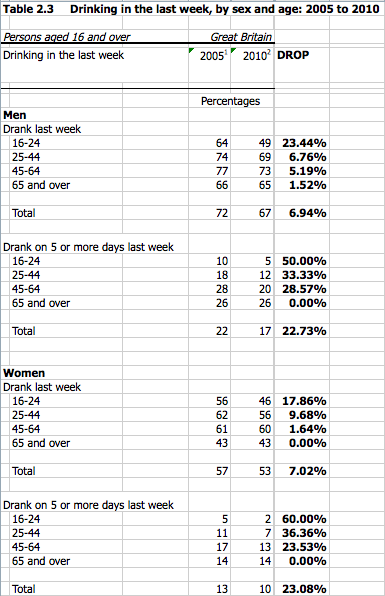
Table 2.3 shows drinking patterns for the week leading up to the interview:


For both men and women, in every age group, people are drinking less than they did in 2005 (except for the oldies, who have stuck to their drinking patterns).

It's not until Table 2.4 that the temperance nuts can find anything remotely resembling bad news:


The percentage of men 65 and over drinking more than 4 units in a day has risen from 21 to 22, while the percentage drinking more than 8 units has risen from 6 to 7. Scary stuff!

And Table 2.4 is still overwhelmingly good news from the perspective of those who want us to drink less. The percentage of 'hard drinking' grannies stayed the same at a whopping 2 percent. In every other category, people were drinking less, with the biggest drops in the 16-24 age bracket. Only a third of young men exceeded 4 units (2 pints of Tetley's), and only a quarter exceeded 8 units (3 pints of Kronenbourg), down from about a half and a third, respectively, in 2005.

On almost every metric, Britain is less boozy than it was in 2005. And yet here's the spin we get from the BBC:


Adults aged over 45 are three times as likely to drink alcohol every day as those aged under 45, results of a lifestyle survey suggest.
That older people drink more often than younger people is not news. Look back at those charts. In 2005, only 10% of men aged 16-24 drank 5 days or more in the week before interview, compared with 18%, 28%, and 26% for those aged 25-44, 45-64, and 65+. Women's drinking shows a similar progression (5%, 11%, 17%, 14%).
Although younger adults were less likely to drink every day, the survey suggests that they were more likely to binge drink than older adults.
...
The survey also found that men tended to drink more often than women
Shocking!

Never mind 2005, what about the difference between 2009 and 2010? Overall, alcohol consumption fell by 3%. It fell 11% for those aged 16-24; 1% for 25-44; 4% for 45-64; and 1% for 65 and over. So even compared to last year, we're drinking less. If the BBC were honest and unbiased, their headline would have read "Alcohol consumption continues to fall". But as Chris Snowdon says, that wouldn't help the campaign for minimum pricing (which seems to have finally succeeded).

It's bad enough that we suffer propaganda from a bunch of compulsorily-funded zealots at the BBC. But it seems that the compulsorily-funded statisticians at the ONS also believe that drinking is a problem, and that this is the government's business:

How the data are used and their importance

The Department of Health estimates that the harmful use of alcohol costs the National Health Service around £2.7bn a year1 and 7 per cent of all hospital admissions are alcohol related. Drinking can lead to over 40 medical conditions, including cancer, stroke, hypertension, liver disease and heart disease. Reducing the harm caused by alcohol is therefore a priority for the Government and the devolved administrations. The GHS/GLF is an important source for monitoring trends in alcohol consumption.


£2.7bn sounds like a lot. That's £2,700 million. So how does it compare with what the government collects in taxes on alcohol? Let's have a look at another report available from the ONS: the Alcohol Duties Statistical Bulletin - December 2011:


Chart 1B shows 2011/12 year-to-date (April to February) Total Alcohol Receipts are £8,678m, which is £68m (0.8%) less than the same period in 2010/11.
Now, I'm sure that "harmful use of alcohol" has costs to individuals and organisations other than the NHS, but only public costs should concern the government. Do the non-NHS public costs really add up to £5.978 billion?

I don't know what's more disturbing - that the government churns out this propaganda, or that people believe it. Either way, it's enough to drive any sane person to drink.

Saturday, 24 March 2012

Minimum price? Yes, Sir Jeremy.

Charles Moore writes:
the government wants to impose a new and oppressive tax on the poor — a minimum price for alcohol. It is always in the name of health that the working class are attacked. But what struck me most about the story was how the decision was taken. According to the Sunday Times, ‘The decision to go ahead was made at a meeting chaired by Jeremy Heywood, the cabinet secretary, and attended by [Andrew] Lansley, Theresa May, the home secretary, and Vince Cable, the business secretary … it was not put to Cabinet.’ This is yet another example of the unacknowledged change in our constitution by which civil servants are put in charge (see also Crown appointments, honours forfeiture, IPSA, the Information Commissioner etc) of their elected political masters. ‘During the meeting,’ the report went on, ‘Heywood is said to have overruled Lansley’s objections.’ By what right?
I hadn't heard of Heywood until last Thursday, when I read a Spectator article by Quentin Letts: Sir Jeremy Heywood is the man who really runs the country:
Sir J. Heywood is a backstairs Bertie, a smudger, a whisper-in-the-PM’s-ear sort who shrivels from public view. The worry for Conservatives, and the rest of us, is that this shrewd murmurer, this eminence grease, has acquired unprecedented power over not only the Prime Minister but also Nick Clegg, Cabinet, the coalition and much of the rest of the state apparat. There is talk of Heywood obstructing secretaries of state, shafting Cameroons and organising Downing Street to his own convenience. We have gone beyond ‘Yes, Minister’ and now have ‘Yes, Sir Jeremy’. Worryingly, no one seems more in hock to him than our soigné, someone-take-care-of-that PM.
...

When Heywood sat before the Public Accounts Committee it was striking that he had acquired many of Clegg’s vocal tics — repeated ‘y’knows’ and ‘sort ofs’ and stuttering checks of a metallic voice. Yet he was unable to disguise entirely the self-satisfaction when he detailed his new responsibilities. ‘Cabinet agenda, Cabinet sub-committees, Cabinet sub-committee membership, Cabinet sub-committee minute-taking — all that falls under me,’ he said. ‘I am in charge.’

Indeed he is. Much though we mock the Greeks and Italians for being run by unelected technocrats, can we truthfully say that we are any better?

Wednesday, 7 March 2012

Propaganda 2012


Most people assume that propaganda is purely a wartime device - something that was inflicted on generations past. But it continues to this day, and nowhere more obviously than in the field of 'public health'.

It works like this:
  1. An anti-tobacco fanatic publishes an absurd report, with claims that aren't supported even by their cherry-picked and carefully-massaged data
  2. The findings are promoted by the BBC News website under the headlines 'Smoke ban: Premature births down' and 'Fewer premature births after smoking ban in Scotland'
  3. BBC Breakfast reports "from a maternity ward in Scotland, where the smoking ban has had an effect on the size and delivery dates of babies"
  4. Ordinary decent people take the BBC report at face value
  5. Any articles questioning the prohibitionist claims reach a much smaller audience. When forwarded to ordinary decent people, the debunking articles often confuse rather than convince. Conflicting claims! Who to trust? Best to err on the side of caution.
  6. The public has been softened up for the next draconian measure:

According to the British Heart Foundation, there are more than nine million smokers in the UK, and smoking remains the UK's biggest cause of avoidable early death.

It says the focus should now shift to the effect of smoking in the home and confined spaces, such as cars, especially where children are present.

A Scottish Government spokesman said: "We are continuing to build upon the achievements made to protect future generations from the devastating effects of smoking such as bans on cigarette vending machines and the displays in shops.

"We are committed to ensuring a new comprehensive robust tobacco control strategy for Scotland is developed this year. This strategy will focus on prevention and cessation and include ambitious targets for reducing smoking across Scotland."

Do read the whole BBC News article, but especially read Christopher Snowdon's excellent blog post on the subject.

On the "drop in the number of babies born prematurely or with low birthweight", the BBC article notes, in passing, that

The investigators believe both are linked to the smoking ban, even though these rates started to go down some months before the ban was introduced and smoking incidence started to creep up again shortly after the ban.
and

while their work suggests a link, it is not proof that one thing necessarily causes another. As with all retrospective studies like this, it is impossible to rule out entirely all other factors that might have influenced the finding.

This is balance, BBC style. The intended message has already been conveyed forcefully in the headline and first eight paragraphs, and it is hammered home again in the concluding paragraphs (quoted above). Even their qualifications stress that "the investigators believe both are linked to the smoking ban" and that "their work suggests a link".

Here, from Christopher Snowdon's article, are the relevant graphs:

And here's the data from the report itself:

Are the BBC headlines justified?

Smoke ban: Premature births down

Fewer premature births after smoking ban in Scotland

Make up your own mind.

Wednesday, 22 February 2012

Schlichter on the NHS

Detlev Schlichter has published an impressive essay on the correct size and proper function of the state. I will highlight further aspects of it in future posts, perhaps along with an explanation of why I am not yet prepared to make the leap to anarcho-capitalism.

For now, here is an excerpt that nicely complements the article by Jamie Whyte featured in my previous post:

Britain’s National Health Service will never deliver a satisfactory service. This is not because the people who work in it are incompetent or lazy. They could be the most motivated, devoted and well-meaning people on the planet and they could still only deliver suboptimal results and do so at considerable cost. Why? Because the NHS has to deliver health services for an entire nation without the help of true market prices and profit and loss accounting. These are the tools of capitalism that – day in and day out – allow the private sector to make informed decisions about best resource use – ‘informed’ because reflecting the preferences and wishes of the customers, the consumers.

Despite the widespread sentimental attachment to the NHS and its superficially appealing motto of delivering health care “free of charge” (obviously not true for the majority of citizens), the fundamental shortcomings of any service organized along socialist lines should be glaringly obvious to anyone: While the still fairly unrestricted private mobile phone industry in Britain delivers the latest advances in telecommunications technology to people across the entire social spectrum with remarkable speed and at constantly falling prices, the nationalized health service bureaucracy has people wait in line even for many routine and long-established procedures and provides such service at ever more staggering cost to the taxpayer.

That health service and education are too important to be left to the private market is a common prejudice that puts economic logic on its head: Because they are important they should be allowed to employ the tools of the private market.

Whyte on the NHS

Another superb article from Jamie Whyte:
A government that really cared about us would make us pay for healthcare. Services provided free to users are not gifts but burdens. They are compulsory purchases.

Take a simple example. How much are you willing to set aside to cover the cost of medical care in your old age? Personally, not much. I would rather spend the money now to enjoy life while still deluded that I am young and healthy. I will save only enough to cover my basic medical needs when old and clapped out: enough for false teeth and a year’s supply of morphine.

But wait. Like everyone else, I am entitled to comprehensive medical care when old, whether I can pay for it or not. So here is what I will do. I won’t save anything and then I will take all I can get free from the NHS, as will everyone else.

How will the government pay for all this “free” medical care? By taxing me, of course, along with my fellow entitlement holders. In the end, my “entitlement” simply obliges me to buy medical treatment that I do not think worth the cost. Which is a strange way for the government to show it cares about me.

As usual, I recommend the whole article.

Tuesday, 10 January 2012

Charities and public health experts

The BBC's attack on alcohol really is relentless. I'd be surprised if a week goes by without at least one story on the subject. Here's the latest:

People should have at least two days a week completely clear of alcohol, a group of MPs says.

It is one of the recommendations in a report by the Commons science and technology committee, which is calling for a review of all government guidelines on alcohol in the UK.

It says there are "sufficient concerns" about the recommendations on how much people should drink.

The report has been welcomed by charities and public health experts.

Charities and public health experts, eh?

Prof Sir Ian Gilmore, from the Alcohol Health Alliance UK, said: "The main recommendation of setting up a review of evidence to come up with clear guidelines would be very valuable indeed."

If you read Christopher Snowdon's blog, that name will be familiar.

Alcohol Concern chief executive Eric Appleby said: "Accessible and reliable public information on alcohol harm is an essential element in tackling Britain's problem with alcohol misuse. However, the government must accept that information alone is insufficient.

A grassroots charity lobbying the government on behalf of concerned citizens? Not according to fakecharities.org:

Summary

Created by the British government in 1985, Alcohol Concern wages an incremental campaign against drinkers and the drinks industry.

Details

...

Its 2008/09 accounts show a total income of £1,137,582, of which:

  • Department of Health (restricted grant): £142,000
  • Department of Health (unrestricted grant): £400,000
  • Big Lottery Fund: £127,275
  • Total £669,275 (58.8% of all income)

It received just £8,186 in public donations.

Who else has the BBC lined up?

Chris Sorek, chief executive of alcohol awareness charity Drinkaware, said: "Drinkaware welcomes the committee's recommendation for greater efforts on helping people understand the unit guidelines and how to use them.
Surely this is a real charity, funded by small donations from millions of concerned citizens. Nope:
Drinkaware is funded by donations from the alcohol industry.

Current funders include major retailers, pub companies and producers who have pledged approximately £5.2 million per year through to 2012. We work with a wide selection of organisations to tackle alcohol misuse, to lead education campaigns and develop corporate social responsibility campaigns.
Quite why the 'alcohol industry' is funding these neo-prohibitionists is anyone's guess. Perhaps someone at the Department of Health had a quiet word with them ...

Wednesday, 28 December 2011

The denormalisation of tobacco continues

BBC News reports:

The government is reminding supermarket retailers in England to remove tobacco displays within the next 100 days.

The Department of Health said the ban, which will come into force on 6 April, would protect young people who were often the target of tobacco promotion.

Smaller shops do not have to change their displays until 2015.

They've been talking about this sort of thing for a long time, but it had somehow escaped my notice that it was actually going ahead. It seems this was a New Labour nanny state initiative that the Coalition predictably failed to kill:

From 6 April 2012, customers in England will still be able to buy cigarettes in the normal way, but the ban - which was announced in 2008 - will mean cigarettes will have to be kept under the counter.

The chief medical officer for England, Prof Dame Sally Davies, said: ''Ending tobacco displays in shops will protect young people from unsolicited promotions, helping them to resist the temptation to start smoking.

"It will also help and support adults who are trying to quit.''

I'd wager that very few 'young people' start smoking spontaneously in response to 'unsolicited promotions' in supermarkets or corner shops. Almost all of them will be offered a cigarette by a friend, and they will initially smoke whichever brands their friends smoke.

As for adults, it's not the government's business to tell them how to live.

In immediate practical terms, there aren't any benefits to this move, only inconvenience and expense for shopkeepers and customers. The real goal is to further denormalise smoking.

Monday, 21 November 2011

Plain packaging?

A recent BBC News article includes an example of Australia's new 'plain' packaging for cigarettes:

Can any Australian look at that package and still feel that they live in a free country?

How long before they try to pull the same trick with beer and wine bottles?

Tuesday, 15 November 2011

Snowdon: We should stop panicking about Boozy Britain


In a change from their regularly scheduled rubbish ...

Throughout October and November, The Independent Online is partnering with the Institute of Ideas’ Battle of Ideas festival to present a series of guest blogs from festival speakers on the key questions of our time.

This gave Christopher Snowdon a chance to publish this superb article.

He begins by summarising the popular narrative about alcohol:
Here’s what everybody knows about Boozy Britain. As a nation we are drinking twice as much as we did sixty years ago. The double whammy of cheaper booze and 24 hour drinking has led to an epidemic of alcohol abuse which threatens to overwhelm the NHS. Alcohol-related hospital admissions have doubled in less than a decade and now stand at over one million per annum. Millions of us put our health in jeopardy by drinking more than the daily alcohol limits.
He then proceeds to present the facts:
Yes, we are drinking more than we did in the immediate post-war years. An economic depression sandwiched by two world wars reduced alcohol consumption to the lowest in our history, but austerity Britain can hardly be considered a typical reference point. Using more relevant benchmarks, we are drinking less than we did in 1914 and very much less than we did in previous centuries. We are drinking only marginally more than we did thirty years ago and—here is a seldom spoken truth—we are drinking less than we did in 2002.

Yes, there are millions of us who exceed our ‘daily limits’ (they’re actually weekly guidelines). How could we not? These guidelines were not based on any real evidence when they were set in 1987 and methodological changes have since dragged several million more of us over the line of ‘hazardous drinking’. Limits that do not allow for tipsiness, let alone drunkenness, deserve to be ignored and yet the percentage of men and women drinking above the ‘limits’ has still been falling for a decade, with the largest decline seen amongst young men.

How to explain the discrepancy?

It can be argued that per capita alcohol consumption is a poor marker for drunkenness, alcoholism and alcohol-related harm, but a doubling in alcohol-related admissions at a time of falling alcohol consumption should raise sceptical eyebrows. Sure enough, the number of medical conditions that are considered ‘alcohol-related’ has tripled during this period and the system of estimating them has undergone what the NHS calls a ‘substantial change’. Hundreds of thousands of hospital visits, predominantly involving the elderly, are now classified ‘alcohol-related’. Our ageing population guarantees further rises in ‘alcohol-related admissions’ in the future.

I thoroughly recommend the whole article.

Friday, 16 September 2011

Ban on junk food ads

From 2008:
A ban on adverts for junk food during television programmes aimed at children under 16 has come into force.

Regulator Ofcom has outlawed adverts for foods high in fat, salt and sugar in an effort to tackle rising childhood obesity levels.

But broadcasters say the quality of children's programmes will be hit by the loss of an estimated £39m in advertising revenue.

Health campaigners had called for a complete ban before the 9pm watershed.

The move is the latest stage in a phased crackdown on advertising during programmes aimed at or appealing to children.

In April 2007, junk food ads were banned during programmes made to appeal to seven to nine-year-olds.

The BBC is always talking about this sort of thing, but I hadn't realised that it had actually happened. I must have been distracted that day, busy earning a living, perhaps.

As Christopher Snowdon says, "heaven forbid that parents should have to say no to their own children".

Saturday, 13 August 2011

NHS for SA?

BBC News reports

South Africa's government has set out its plans to introduce a universal health care scheme.

A pilot scheme in 10 areas is to start in April 2012, and will then be phased in nationally over the next 14 years.

"These first steps towards establishing national health insurance are truly historic," the health minister said.

Analysts say South Africa is one of the world's most unequal societies, where quality health care is skewed towards the private sector.

Oh dear, not the ghastly private sector!

Onward Socialist Soldiers!
"If you earn above a certain income you will be required by law to make a contribution to the NHI Fund. It will not be possible to opt out of this responsibility," he said.
Coercion! That's what we like to see!
"The central challenge to the stability and well-being of our nation is reducing the deep inequality between rich and poor, between privilege and deprivation. This goes to the heart of South Africa's future," Mr Motsoaledi said.
Ah yes, inequality: the root of all evil. Except not.

Let's just hope the South Africans aren't foolish enough to emulate our Soviet-style healthcare system. Here in the UK, the government is not content to confiscate wealth from some of its citizens in order to pay for the healthcare of others. That works for most other western democracies, but not us. Here we're apparently convinced that the government does a much better job of running things than the private sector, so the government must provide healthcare, as well as requisitioning the funds for it.

It's such a great idea, I wonder why we don't bring back the National Coal Board.

Thursday, 14 July 2011

A nanny superstate

In my previous post, I noted that our government is unnecessarily illiberal even by EU standards.

Though there are good reasons to resent the restrictions the EU imposes on us today, we should be even more concerned about their plans for the future.

The Eurocrats are in the process of harvesting bad laws from across the continent, and elevating them to the European level.

The smoking ban is a case in point. Here it is, straight from the Eurocrats themselves:

EU countries urged to pass tougher anti-smoking laws.

The commission is calling for an EU-wide ban on smoking in public places by 2012.

Currently all EU countries have regulations of some kind designed to protect people from second-hand smoke and its harmful effects. But the rules vary widely from country to country.

The UK and Ireland have the strictest laws - a complete ban on smoking in indoor workplaces and public places, including public restaurants and bars. Bulgaria is due to follow suit in 2010.

Greece, Italy, Malta, Sweden, Latvia, Finland, Slovenia, France and Holland have introduced smoke-free legislation that still allows special enclosed smoking rooms.

The EU is now proposing that uniform laws be drafted for all 27 countries to regulate smoking more strictly in public areas and workplaces.

Second-hand, or passive, smoke has been linked to heart disease and lung cancer. Back in 2002, some 19 000 non-smokers are thought to have died in the EU due to second-hand smoke at home or at work.

Tobacco is the leading avoidable cause of death in the EU, claiming some 650 000 lives a year. One in three Europeans - about 170 million - uses tobacco.

As part of a new anti-smoking campaign, the EU is inviting people to upload videos showing how they kicked the habit. Hundreds have responded and their work can be seen on the campaign website.

For a life without tobacco

Bad laws entrenched at the European level are much harder to repeal. If 51% of MPs wanted to reverse the UK smoking ban, they could do it tomorrow. But if 100% of British MEPs wanted to reverse an EU smoking ban, they wouldn't be anywhere close to a majority in the European Parliament.

British MEPs control just 72 seats out of 736 (9.8%). Even if they were united on an issue, they would need to convince 297 of their European colleagues. For 60 million Britons to re-allow smoking in British pubs, we would need to consult the representatives of 440 million foreign residents, many of whom will never even visit Britain, much less live and work here.

Having sacrificed millions of lives in defence of our centuries-old freedoms, it is astounding that we have surrendered so much sovereignty without a shot being fired.

Wednesday, 13 July 2011

Which should be the bigger story?

What's worse, hacking somebody's phone, or allowing 25,000 people to die each year from hospital-acquired DVT?

English hospitals face being "named and shamed" for not screening patients for deep vein thrombosis (DVT), NHS medical director Sir Bruce Keogh has said.

NHS trusts are required to screen 90% of hospital patients for the condition.

But fewer than half are managing this, according to the NHS, which estimates 25,000 people die each year from hospital-acquired DVT.

One assessed just one in four patients and another barely one in 10. Sir Bruce said this was "absolutely disgraceful".

"In the sort of NHS that I want to work in and be treated in, I don't think that level of practice is acceptable."

DVT involves blood clotting in the legs and can be fatal if a clot breaks off and travels in the blood up to the lungs and causes a blockage, known as a pulmonary embolism.
...
"Preventative treatment does reduce almost to zero the incidence of DVT," said John Black, the outgoing president of the Royal College of Surgeons.

"This is the number one clinical priority for me and my colleagues," said Sir Bruce.

"Some 25,000 people die a year from something that is preventable. The same sort of number which die from stroke and other major conditions which are far less preventable."

Wednesday, 29 June 2011

The Last Ditch: Advancing liberty, one smoke at a time

A good post from Tom Paine:

The cross-party group of MPs hosting this afternoon's sunny reception on the Commons Terrace comprised only non-smokers. Two, like me, had never smoked but felt strongly about liberty. The Labour host Roger Godiff- to cries of "don't give them ideas" - suggested it would be more honourable for antismokers to call honestly for abolition. Until then, if it was legal, it was wrong to proscribe it. It was nostalgic to hear a Labour man talk in such terms; an echo of the days when the working-class members of that party at least, were not looking to replace one boss class with another.

They all spoke eloquently enough to a good crowd, but I was most moved by the plain speaking of Mick McGlasham, General Secretary of the Workingmens Clubs & Institutes Union (CIU). He was genuinely baffled that, when pubs and clubs are ready to make ventilated smoking areas, anti-smoking fanatics are still determined to shatter the institutions at the heart of working-class communities. "Just give us the technical specs", he said, "and we will comply. It's time for some commonsense on smoking legislation". He also pointed out that young children are being more exposed to cigarettes because their parents now have nowhere to smoke but at home.